Is Gynecomastia a Big Surgery? What You Should Really Expect
If you’ve been thinking about correcting chest enlargement, chances are this question has crossed your mind more than once: Is gynecomastia a big surgery?
It’s rarely asked casually. Usually, it comes after years of discomfort, hesitation, and quiet self-consciousness. You may have tried changing your workouts, adjusting your diet, or convincing yourself that the concern isn’t serious enough to consider surgery. Yet the question keeps returning, because the chest appearance hasn’t changed.
When patients begin exploring a gynecomastia procedure in Delhi, they are not only evaluating a medical treatment. They are trying to understand how much of their life the surgery will affect. Will recovery be difficult? Will it feel overwhelming? Is it something serious or something manageable?
The answer lies somewhere between perception and reality.
Gynecomastia surgery is indeed a surgical procedure. But medically speaking, it is not considered a major operation when performed under proper conditions by an experienced specialist. The misunderstanding often comes from the emotional weight attached to the decision rather than the physical demands of the surgery itself.
Why Gynecomastia Feels Like a Bigger Problem Than It Looks?
Gynecomastia is not simply excess fat. It involves firm glandular tissue that develops beneath the nipple area, often due to hormonal influences, genetics, medications, or body changes over time. Unlike fat, this tissue does not respond to exercise or weight loss.
Many men spend years attempting to correct the issue through fitness alone. When results don’t change, frustration builds quietly. Clothing choices become cautious. Posture changes subconsciously. Activities like swimming or wearing fitted shirts begin to feel uncomfortable.
By the time someone considers a gynecomastia procedure in Delhi, the decision has usually been emotionally processed long before it becomes medical.
This emotional buildup is often why the surgery feels “big,” even though the procedure itself is relatively controlled and predictable.
Have questions or want to get started? We are ready to help you with a smile!
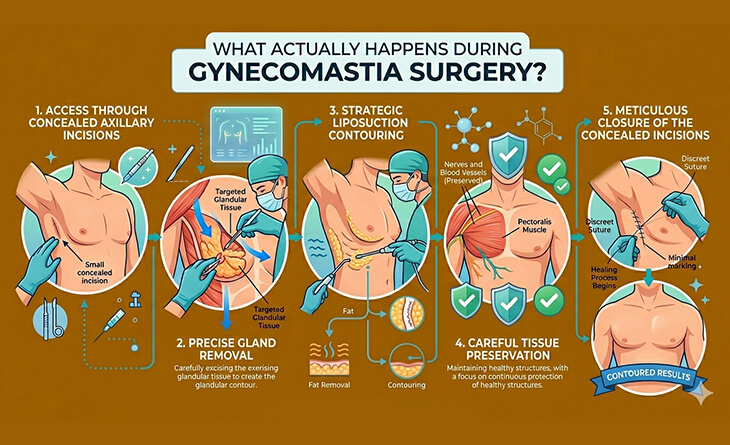
What Actually Happens During Gynecomastia Surgery?
Understanding how the procedure is performed often reduces a great deal of anxiety for patients. Gynecomastia surgery today is far more refined than many people imagine. Modern approaches focus not only on removing excess gland tissue but also on restoring a natural masculine chest contour with minimal visible scarring.
Dr Rajat Gupta performs gynecomastia surgery using his OCCULT technique, a specialised surgical approach designed to correct chest projection while keeping scars discreet and almost invisible. The word OCCULT reflects the central philosophy of the method: the correction is visible, but the surgical marks remain concealed.
In traditional gynecomastia surgery, incisions are commonly placed around the areola or directly on the chest. While these methods can be effective, they may leave small but noticeable scars in some patients. The OCCULT technique modifies this approach by placing the surgical entry points within the natural creases of the armpits (axillary region). These incisions remain hidden when the arms are in a natural resting position, allowing the chest itself to heal without visible marks.
Through these carefully positioned access points, Dr Rajat Gupta removes the dense glandular tissue responsible for chest prominence. Gynecomastia is not simply excess fat; in most cases it involves firm gland tissue that cannot be eliminated through exercise or weight loss. The OCCULT technique allows this gland to be removed precisely while maintaining smooth transitions across the chest.
Liposuction is often incorporated as part of the procedure to contour the surrounding fatty layer. Rather than removing fat aggressively, the technique focuses on layered sculpting, ensuring that the chest wall appears flat yet naturally contoured. This prevents the overly hollow appearance that can sometimes occur when tissue is removed without proportional planning.
The surgical process typically involves several carefully controlled steps:
- Access through concealed axillary incisions, allowing surgical instruments to reach the gland tissue while keeping the chest surface free of visible scars.
- Precise gland removal, targeting the dense tissue responsible for the projection and fullness characteristic of gynecomastia.
- Strategic liposuction contouring, refining the surrounding fat layers so the chest blends smoothly with the lateral chest wall and underarm area.
- Careful tissue preservation, ensuring the skin retracts naturally and the nipple–areola complex maintains a balanced position on the chest.
- Meticulous closure of the concealed incisions, allowing healing to occur within the natural folds of the armpit where scars are far less noticeable.
Most gynecomastia procedures using the OCCULT technique are completed within one to two hours, depending on the severity of gland enlargement and the amount of contouring required. Because the surgery is minimally invasive and performed under controlled conditions, patients usually return home the same day after a short observation period.
Another advantage of this approach is the recovery experience. With limited external incisions and careful tissue handling, swelling and discomfort tend to remain manageable. Patients typically resume light daily activities within a few days, with gradual return to exercise as healing progresses.
When performed by an experienced cosmetic surgeon in Delhi, like Dr Rajat Gupta, gynecomastia surgery using the OCCULT technique focuses on three essential outcomes: a flat, masculine chest contour, minimal visible scarring, and a result that looks natural both in motion and at rest. For many men, this combination of effective correction and discreet surgical design makes the transformation feel far less like “surgery” and far more like restoring the chest they always expected to have.
So, Is It Medically a Major Surgery?
From a clinical standpoint, gynecomastia surgery is classified as a moderate outpatient procedure rather than a major operation.
It does not involve internal organs, extended hospital stays, or prolonged immobility. Patients are encouraged to walk and resume light activities soon after surgery, which supports healing rather than delaying it.
The body is working mainly at the level of skin, fat, and glandular tissue. Because deeper anatomical systems remain untouched, recovery tends to be smoother compared to many other surgical procedures.
This distinction is important. The word “surgery” often carries images of complexity and risk, but modern gynecomastia correction is designed to minimise disruption while achieving meaningful change.
Recovery: The Part Most Patients Worry About
Recovery is often imagined as painful or restrictive. In reality, most patients describe the experience differently once they go through it.
The first few days usually involve tightness across the chest and mild soreness, similar to muscle fatigue after an intense workout. Compression garments provide support and help control swelling, making movement more comfortable.
Within a week, daily routines begin to feel normal again. Desk work typically resumes early, and gradual improvement becomes noticeable each day. Over the following weeks, swelling reduces, and chest contours settle naturally.
What many patients notice most is not discomfort but relief. The physical heaviness or awkwardness they carried for years begins to fade, sometimes faster than expected.
The Psychological Shift After Surgery
One aspect rarely discussed openly is the emotional change that follows treatment.
Patients often describe standing straighter without consciously trying. Clothing choices expand. Social situations feel easier. Activities once avoided become routine again.
These changes are subtle but meaningful. They explain why many individuals later say the hardest part was deciding to proceed, not recovering afterwards.
A thoughtfully planned gynecomastia procedure in Delhi addresses both physical structure and personal confidence, even though the surgery itself remains medically straightforward.
Understanding Cost Without Confusion
Another concern patients naturally have involves pricing. The gynecomastia surgery cost in Delhi varies because no two cases are identical.
Factors influencing cost include the amount of gland tissue present, whether liposuction is required, surgical complexity, and post-operative care planning. Transparent consultation helps clarify these elements early, keeping expectations realistic.
Cost discussions should feel informative rather than transactional. Surgery planning works best when patients understand what contributes to safety and long-term results.
Safety and Long-Term Outcomes
When performed under accredited surgical standards and with high-end surgical techniques such as OCCULT (the hidden scar technique), gynecomastia surgery is considered safe for healthy individuals. Careful patient evaluation, controlled anaesthesia, and structured follow-up care all contribute to predictable outcomes.
Removed gland tissue does not return. Maintaining stable weight and overall health helps preserve results over time, allowing patients to enjoy lasting improvement without ongoing treatment.
A Thought Before You Decide
Gynecomastia surgery often feels intimidating because it represents change, not because it is medically overwhelming. Once patients understand the process, many realise the procedure itself is far smaller than the years spent adapting to the concern.
If you are considering a gynecomastia procedure in Delhi, a personalised consultation with Dr Rajat Gupta allows you to explore options calmly, understand recovery honestly, and move forward with clarity rather than uncertainty. The goal is not dramatic transformation, but comfortable confidence that feels natural every day.
FAQs About Gynecomastia Surgery
A Gynecomastia Procedure in Delhi is a real surgical treatment, but not classified as major surgery medically. It is typically performed as a day-care procedure with a manageable recovery for most healthy patients.
Most patients experience soreness rather than sharp pain. Discomfort improves steadily over the first week and is controlled effectively with medication and compression support.
Light activities usually resume within a few days, while exercise returns gradually after medical clearance. Recovery timelines vary slightly depending on individual healing.
Removed gland tissue does not regenerate. Maintaining a stable weight and healthy habits helps ensure long-term results after a Gynecomastia Procedure in Delhi.
The Gynecomastia Surgery Cost in Delhi depends on severity, the surgical technique required, and contouring complexity needed to achieve balanced results.
A consultation with an experienced Cosmetic surgeon in Delhi determines whether enlargement is caused by gland tissue, fat, or both, ensuring the correct treatment approach.

Dr. Rajat Gupta
MBBS, MS, DNB(Gen. Surg.),
DNB (Plastic Surgery)
Dr. Rajat Gupta is a board certified plastic surgeon in India with 18+ years of experience to back his expertise in the domain of aesthetic surgeries.
Having completed his training from Maulana Azad Medical College and equipped with a thorough understanding of aesthetic needs of people, Dr. Gupta strives to offer the best remedies and cosmetic procedures outfitted with the latest technology to the aspirants in India and across the globe. To book an appointment, call: +91-9251711711 or email: [email protected]
Share this post

Related Posts
All You Need To Know About Male Breast Reduction!
Breasts being the vanity of a woman, we all are accustomed to... read more

Gynecomastia surgery recovery pictures
Gynecomastia is the development of breast tissue among men, or male boobs... read more

What Men Need to Know Before Having Gynecomastia Surgery?
Gynecomastia, a condition characterized by the enlargement of breast tissue in men,... read more

Gynecomastia surgery bruising
Gynecomastia or development of breasts in men is a very common problem,... read more

Can Gynecomastia Come Back After Surgery?
No, if the gynecomastia surgery is performed by a skilled and experienced,... read more

Chest Fat and Gynecomastia – Differences Explained
Male breasts are a central point of contention in many men’s lives,... read more

Grade 2 gynecomastia
Gynecomastia or male boobs is a common problem which many men face.... read more

How Long to Wear a Compression Vest after Gynecomastia Surgery?
Gynecomastia surgery is a cosmetic procedure that reduces excess breast tissue in... read more

Plastic Surgery Q & A with Dr Rajat Gupta, RG Aesthetics
How Painful is a Tummy Tuck?One of the most crucial questions that... read more

Which doctor treats gynecomastia?
When men develop breast tissue, it is referred to as gynecomastia. It... read more