Rebuilding What Breast Cancer Took, At Your Own Pace, In Your Own Way
Breast reconstruction surgery rebuilds the shape of the breast after a mastectomy or lumpectomy performed for breast cancer treatment. Reconstruction may use implants, your own body tissue (flap reconstruction), or a combination of both approaches.
Patients often ask:
- What is breast reconstruction surgery?
- Can breast reconstruction be done at the same time as mastectomy?
- Can I have reconstruction years after my mastectomy?
The answer is that reconstruction can often be performed immediately during cancer surgery or delayed until months or even years later, depending on your treatment plan and personal preference.
If you are reading this shortly after a diagnosis, it is important to know that reconstruction does not need to be decided today. The goal is to help you understand your options clearly and make decisions at a pace that feels right for you.
This page explains breast reconstruction after mastectomy, including implant and flap options, timing choices, recovery, insurance coverage, and long-term outcomes.
- Implant and Flap Reconstruction
- Immediate or Delayed Reconstruction
- Coordinated with Your Oncology Team
- Often Covered by Insurance

Procedure at a glance
Download A Patient Guidebook Of Breast Reconstruction?
Breast Reconstruction Best Results / Before & After
A NOTE OF REASSURANCE
You Do Not Have to Decide Everything at Once
Some women choose immediate breast reconstruction patients often enquire about, while others prefer delayed breast reconstruction options after completing cancer treatment. Both approaches are medically valid.
Breast reconstruction is not about forgetting what has happened. It is about helping you feel comfortable in your body again, if and when you choose to do so.
Many women decide on reconstruction months or years after treatment. There is rarely a deadline, and there is no pressure to make decisions before you feel ready.
The first consultation is simply a conversation. No decisions are required.
WORKING WITH YOUR CANCER TEAM
Reconstruction Works Alongside Your Cancer Care
Breast reconstruction after cancer patients seek is always planned alongside cancer treatment, never separately from it.
Your oncologist, breast surgeon, radiation specialist, and reconstructive surgeon work together to create a plan that prioritises cancer treatment while supporting reconstruction goals.
This coordination is particularly important when:
- Radiation therapy is planned.
- Chemotherapy is required.
- Delayed reconstruction is being considered.
- Symmetry procedures may be needed.
Patients frequently ask:
“Does breast reconstruction affect cancer detection?”
Modern reconstruction techniques are designed not to interfere with routine cancer follow-up or surveillance.
Cancer treatment remains the priority, while reconstruction is carefully integrated into the overall treatment pathway.
THE OPTIONS
Your Reconstruction Options, Explained Gently
There are several established options, and the most appropriate choice depends on your anatomy, cancer treatment, recovery goals, and personal preferences.
Implant-Based Reconstruction
Implant reconstruction uses a silicone implant to recreate breast volume and shape.
Patients frequently ask:
“What is a tissue expander?”
A tissue expander is a temporary device placed beneath the skin and gradually filled over time to create space for a permanent implant.
Implant reconstruction generally involves:
- Shorter surgery
- Faster recovery
- No additional donor site elsewhere on the body
This is a common option for post mastectomy reconstruction patients.
Autologous (Flap) Reconstruction
Flap reconstruction uses your own tissue from another part of the body to rebuild the breast.
Patients often ask:
“What is DIEP flap reconstruction?”
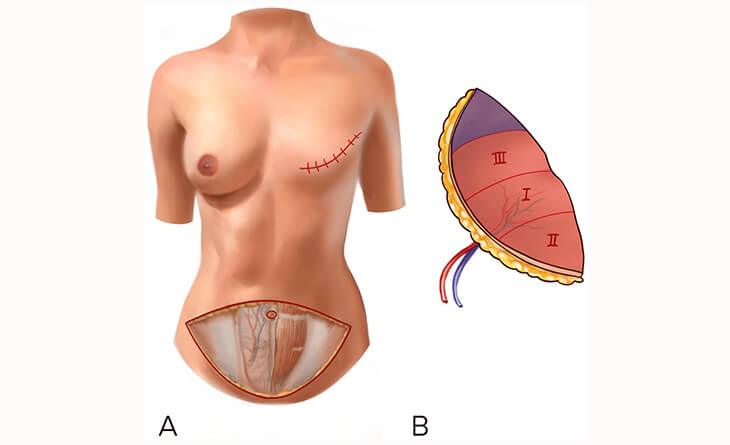
DIEP flap reconstruction uses skin and fat from the lower abdomen while preserving the abdominal muscles, creating a breast using the patient’s own tissue.
Flap reconstruction generally offers:
- A more natural feel
- Long-term durability
- Better integration with the body’s natural ageing process
However, it involves a longer operation and recovery period.
Implant vs Flap Reconstruction
Patients frequently compare:
At a Glance: Reconstruction Options
A summary for quick reference. The right option for you is decided together, with your cancer team, at a pace that suits you.
| Option | How It Works | Often Suited To |
|---|---|---|
| Implant-Based Reconstruction | The breast mound is rebuilt using a silicone or saline implant, sometimes after a tissue expander is used first to gently stretch the skin. | Patients who prefer a shorter operation and recovery, with no second surgical site on the body. |
| Autologous (Flap) Reconstruction | The breast is rebuilt using the patient’s own tissue, taken from the abdomen, back, or thigh, with its blood supply preserved. | Patients who want the most natural feel and a result that ages like natural tissue, and who have suitable donor tissue. |
| Combined (Hybrid) Reconstruction | An implant is combined with the patient’s own tissue or fat grafting to refine shape and softness. | Patients who need both volume and natural contour, or whose tissue alone is insufficient. |
| Nipple and Areola Reconstruction | A later, smaller stage that recreates the nipple and areola once the reconstructed breast has settled. | Patients completing their reconstruction journey who wish to restore the full appearance of the breast. |
Combined (Hybrid) Reconstruction
Some patients benefit from combining implants with fat grafting in breast reconstruction to improve softness, contour, and symmetry.
Nipple and Areola Reconstruction
Patients often ask:
“Can the nipple be reconstructed too?”
Yes. Nipple reconstruction after mastectomy is usually performed after the breast has healed and settled. It may involve local tissue reconstruction, medical tattooing, or a combination of both.
For many women, this represents the final stage of the reconstruction journey.
At a Glance: Reconstruction Options
The right reconstruction option is chosen together with your cancer team, based on your treatment plan, anatomy, and personal priorities. There is no universally best option—only the option that is best for you.
TIMING
Immediate or Delayed: There is No Wrong Choice
Many patients ask, “Can breast reconstruction be done at the same time as mastectomy?”
The answer is often yes. Immediate breast reconstruction begins during the same operation as the mastectomy, allowing the reconstruction process to start before you wake from surgery. For many women, this can make the transition after breast cancer treatment feel less abrupt.
Immediate breast reconstruction is suitable when cancer treatment plans allow it and when the patient feels comfortable making that decision before surgery.
Another common question is, “Can I have reconstruction years after my mastectomy?”
Yes. Delayed breast reconstruction can be performed months or even years after cancer treatment. Many women choose this option because it gives them time to focus on recovery first and reconstruction later.
Delayed breast reconstruction is often recommended when radiation therapy is part of the treatment plan, as radiation can affect healing and reconstruction outcomes.
The most important thing to remember is that there is no deadline. The right timing depends on your treatment, your recovery, and your personal readiness.
WHAT TO EXPECT
What the Procedure Involves
Every breast reconstruction surgery is planned individually and coordinated with your cancer care team.
General anaesthesia in an accredited surgical facility.
Implant-based reconstruction typically takes 1 to 1.5 hours. Flap reconstruction procedures may take 4 to 5 hours because they involve transferring tissue from another area of the body.
Breast reconstruction is often completed in stages. The first stage rebuilds the breast mound, while later procedures may improve symmetry or perform nipple reconstruction after mastectomy.
Implant reconstruction generally involves a shorter operation and recovery. Flap reconstruction uses your own tissue and may provide a more natural feel and appearance.
When reconstruction involves only one breast, procedures such as a lift, reduction, or augmentation on the opposite breast may be discussed to improve balance.
Implant reconstruction usually requires a shorter stay, while flap reconstruction may require additional monitoring and recovery time.
RECOVERY
Recovery: Gentle and Supported
Recovery varies depending on whether implant reconstruction, flap reconstruction, or combined reconstruction is performed.
Rest and healing are the priorities. Temporary swelling, discomfort, and fatigue are expected. Surgical drains may be used for a short period. Can return to desk jobs.
Most patients gradually return to routine activities. Implant-based recovery is generally quicker than flap reconstruction recovery because there is no donor-site healing.
Swelling continues to settle and the reconstructed breast begins to develop its long-term shape.
The reconstruction continues to refine. Additional procedures such as fat grafting in breast reconstruction or nipple reconstruction may be planned once healing is complete.
A structured follow-up programme is coordinated alongside your ongoing cancer surveillance whenever possible.
INSURANCE
Is Breast Reconstruction Covered by Insurance?
One of the most common questions patients ask is, “Is breast reconstruction covered by insurance in India?”
In many cases, yes.
Because breast reconstruction after mastectomy is often considered a medically necessary part of breast cancer treatment and recovery, many health insurance policies provide partial or full coverage.
Coverage depends on:
- Your individual insurance policy
- The recommendations of your oncology team
- Medical documentation supporting reconstruction
- Your insurer’s approval criteria
At consultation, guidance can be provided regarding documentation and insurance requirements. While no practice can guarantee approval, appropriate medical records and treatment documentation can help support your claim.

Don't take biggest decision of life
Without getting complete information!
RISKS
Risks: Honest and Clear
Breast reconstruction is considered safe when performed by a board-certified reconstructive surgeon in an accredited facility. However, like any operation, it carries risks.
- Bleeding
- Infection
- Anaesthetic complications
- Delayed wound healing
Patients researching implant vs flap breast reconstruction often ask about implant-specific risks.
These may include:
- Capsular contracture
- Implant rupture over time
- Implant displacement
- Future revision surgery
Flap procedures carry additional risks related to the transferred tissue and donor site, including healing problems or reduced blood supply to the flap.
Patients frequently ask, “Can I have reconstruction after radiation?”
Yes, but radiation can affect healing, breast shape, and tissue quality. This is one reason reconstruction timing is carefully coordinated with the oncology team.
Most women recover well and are pleased with their reconstruction. A full written explanation of risks, benefits, recovery expectations, and treatment options forms part of the consultation and consent process before surgery.
Transparent Pricing
What Breast Reconstruction Costs?
The cost of breast reconstruction surgery depends on the type of reconstruction, the number of stages involved, and the complexity of the procedure. Importantly, many patients undergoing breast cancer reconstruction may receive partial or substantial insurance coverage.
What Determines Cost?
- Implant vs flap breast reconstruction approach
- Immediate or delayed reconstruction
- Whether one or both breasts require reconstruction
- Use of tissue expanders
- Hospital stay and surgical complexity
Insurance and Cost
Patients frequently ask about breast reconstruction cost with insurance. Because reconstruction is often considered part of breast cancer treatment, insurance may cover a significant portion of the overall cost. Your likely insurance position will be discussed during consultation.
WHY THIS PRACTICE
Why Patients Choose This Practice for Reconstruction?
Patients searching for the best breast reconstruction surgeon often value:
- Board-certified plastic and reconstructive surgery expertise.
- International fellowship training in breast surgery.
- Experience in both implant-based and flap reconstruction techniques.
- Careful coordination with oncology and breast cancer teams.
- Support for immediate and delayed breast reconstruction decisions.
- Guidance regarding insurance documentation and approvals.
- ISAPS-accredited training centre standards.
- Compassionate, patient-centred follow-up throughout the reconstruction journey.
Most importantly, reconstruction recommendations are based on what is right for you, not on a single preferred technique.
Common Questions
Common Questions About Breast Reconstruction
No. Breast reconstruction can be performed immediately during mastectomy or many years later. There is no strict deadline for reconstruction.
In many cases, yes. Breast reconstruction after cancer is often regarded as a medically necessary part of treatment and may qualify for insurance coverage depending on your policy.
Implant reconstruction uses a silicone implant, often with a tissue expander. Flap reconstruction uses your own tissue and generally provides a more natural feel. The best option depends on your anatomy, treatment history, and personal preferences.
Yes. This is known as immediate breast reconstruction and can often be performed during the same operation as the mastectomy.
Many reconstructed breasts look natural. Flap reconstruction usually provides the most natural feel because it uses your own tissue.
Yes. Reconstruction after radiation is possible, although the timing and technique may need adjustment because radiation affects healing and tissue quality.
No. Breast reconstruction is planned carefully so it does not interfere with cancer surveillance or ongoing follow-up appointments.
Breast reconstruction recovery time varies by procedure. Implant reconstruction generally involves a shorter recovery, while flap reconstruction may require six to eight weeks or longer.
Yes. Nipple reconstruction after mastectomy is usually performed after the reconstructed breast has healed and settled.
The cost of breast reconstruction generally ranges from INR 2,00,000 to INR 6,00,000 depending on the technique used and whether multiple stages are required. Insurance coverage may significantly reduce out-of-pocket expenses.
THE FIRST CONSULTATION
What to Expect at Your First Consultation?
A breast reconstruction consultation is designed to provide clarity, support, and information.
Your consultation typically includes:
- Discussion of your diagnosis and treatment journey.
- Review of immediate versus delayed reconstruction options.
- Explanation of implant and flap reconstruction techniques.
- Assessment of breast symmetry requirements.
- Discussion of nipple reconstruction options.
- Guidance regarding insurance coverage and documentation.
- Recovery expectations and treatment planning.
There is no pressure to make a decision during the consultation. The goal is simply to help you understand your options.
Book a Compassionate Consultation
Whether you are ready to begin, or simply want to understand your options, a consultation with Dr Rajat Gupta is a calm and pressure-free place to start.