
RG Flap Technique Surgery vs. Other Breast Reduction Methods
Breasts that are overly large can affect posture, movement, clothing comfort, and daily confidence. Women who live with heavy breasts often feel constant strain in their shoulders and neck, deal with deep bra-strap grooves, and struggle to find clothes that fit well. For years, breast reduction surgery has offered relief by reducing volume and improving symmetry, yet not every technique delivers long-term satisfaction. The biggest challenge with older methods is that breast shape may look lifted immediately after surgery, but over time, the lack of internal support can lead to sagging again.
To address these concerns, advancements in body contouring have brought forward a new approach: RG Flap Technique Surgery. By preserving crucial internal tissue support and strategically repositioning volume, this method enhances both function and aesthetics. In contrast, many traditional methods rely heavily on the skin to support breast weight, which can weaken with ageing. This blog will help you understand how different breast reduction techniques compare, and why the flap-based approach delivers stable results that continue to look youthful.
4 Main Types of Breast Reduction Surgery
The most commonly used techniques in Breast Reduction Surgery are:
- Traditional Skin-Pattern Reduction
Volume reduction through skin removal and tissue excision, usually with an anchor-shaped scar. - Vertical Reduction (Lollipop Method)
Less scarring than the anchor approach, but still dependent on skin tightening for support. - Liposuction-Only Reduction
Suitable only for fatty breasts; it does not help when glandular tissue is significant. - Flap-Based Reductions
Techniques that preserve internal tissue to support long-term breast shape.
Each method has its own strengths and limitations. The major difference is whether the result remains lifted over time. This is exactly where RG Flap Technique Surgery stands apart.
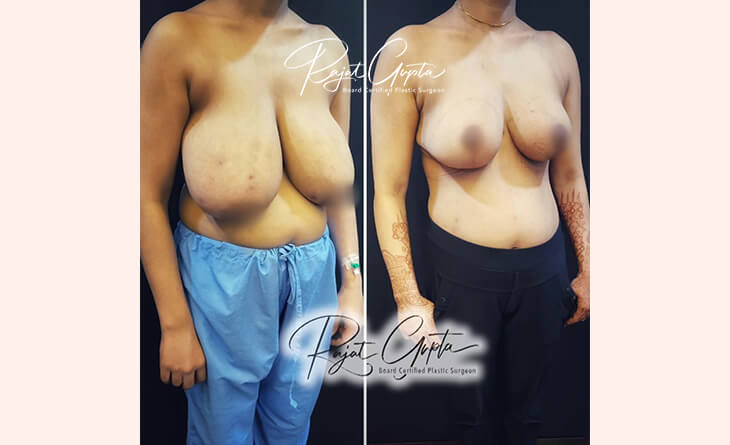
Have questions or want to get started? We are ready to help you with a smile!
What Is the RG Flap Technique Surgery?
RG Flap Technique Surgery, a special technique devised by Dr Rajat Gupta, uses carefully preserved internal breast tissue to build a supportive foundation beneath the newly shaped breast. Instead of discarding all lower tissue, the surgeon retains a structured flap and anchors it securely to deeper tissues. This approach acts like an internal bra that continues to hold the shape strongly even as the skin ages.
Key benefits of this breakthrough technique include:
- Better upper-pole fullness
- Well-supported nipple and breast projection
- Longevity of the lifted result
- Reduced sagging over the years
- More natural-looking shape in all positions
Skin becomes a covering layer rather than the primary force holding the breast up, which means the shape does not rely on skin elasticity alone.
Comparing RG Flap Technique Surgery with Older Reduction Methods
Traditional Anchor Reduction vs RG Flap Technique Surgery
The anchor (Inverted-T) reduction has been used for decades in Breast Reduction Surgery. It removes excess skin and breast tissue and lifts the breast. The major limitation is that the lift depends almost entirely on skin tension.
Where the Anchor Technique Falls Short:
- Skin gradually stretches again, particularly in heavier breasts
- Upper-pole flatness develops over time
- Breast footprint widens at the base
- Visible scars are extensive
- Results may look good at first, but sagging returns
How RG Flap Technique Surgery Improves Outcomes:
- A supportive internal flap acts like an engineered internal bra
- Skin plays a covering role, not a supporting one
- Upper-pole roundness is preserved long-term
- Scars settle better due to reduced tension
- Nipple position remains stable without drifting downward
In clinical terms, the internal architecture —not the skin envelope —determines longevity, and this is exactly what the RG flap reinforces.
Vertical (Lollipop) Reduction vs RG Flap Technique Surgery
The vertical method reduces scarring by avoiding the horizontal incision. It is popular among non-specialised surgeons because it appears “lighter” surgically.
Challenges with Vertical Technique:
- Suitable mainly for mild-to-moderate ptosis
- Limited ability to reshape the lower pole
- Skin still bears most of the weight
- High chance of bottoming out in heavier tissues
- Breasts develop a long, narrowed shape over time
RG Flap Advantage:
- Works equally well for moderate and severe reductions
- Maintains roundness in both upper and lower poles
- Internal suspension prevents shape collapse
- Projection remains stable during ageing
Simply put, lollipop techniques are lifting from the outside; the RG flap lifts from within.
Liposuction-Only Reduction vs RG Flap Technique Surgery
Liposuction-only treatments temporarily gained popularity because they use tiny incisions. But they do not address structural problems.
Why Liposuction Alone Fails as Breast Reduction:
- Removes fat only, not glandular tissue (which is the real weight-bearing issue)
- Does not lift the breast or change nipple position
- Leaves loose skin hanging unsupported
- Can worsen ptosis if skin is already weak
RG Flap Advantage:
- Removes gland and fat while reshaping the mound
- Supports the nipple-areola complex anatomically
- Firms the breast and improves footprint width
- Enhances the silhouette inside and outside clothing
Liposuction alone cannot replace a scientific Breast Reduction Surgery approach.
Free Nipple Graft Technique vs RG Flap Technique Surgery
This approach is sometimes used in extremely large, heavy breasts where the nipple must be completely detached and grafted onto the breast surface.
Problems with Free Nipple Grafting:
- Nipple sensation is often permanently lost
- Inability to breastfeed afterwards
- Flattened, unnatural breast appearance
- Nipple looks “stuck-on,” not organically positioned
- Texture and pigmentation changes over time
RG Flap Advantage:
- Nerve and blood supply preserved
- Nipple remains functional and responsive
- Breast looks natural, not reconstructed
- Feminine curvature maintained
The flap-based method prioritises both form and function.
Inferior Pedicle (Older Flap) Techniques vs RG Flap Technique Surgery
Earlier flap methods preserved a block of lower breast tissue to support the nipple. They were more advanced than skin-only lifts but still had notable drawbacks.
Inferior Pedicle Concerns:
- Poor upper-pole fullness
- Heavy lower pole leads to bottoming out
- Wider breast footprint
- Less control over aesthetic sculpting
RG Flap Technique Surgery Raises the Standard:
- Repositions tissue to where it is visually needed
- Reinforces the internal sling to prevent descent
- Enables customizable shaping
- Maintains long-term projection and a narrower base
This is evolution, not merely an alternative.
Why Internal Support Changes Everything?
Breast weight is significant. Over time, gravity always defeats skin-dependent techniques.
The engineering principle is straightforward:
- If skin is holding the weight → sagging returns
- If the structure holds the weight → shape stays lifted
RG Flap Technique Surgery creates that structure. It is designed to withstand decades of movement, ageing, and lifestyle changes.
Quick Procedure Comparison: What Patients Experience
| Feature | Anchor / Vertical / Liposuction | RG Flap Technique Surgery |
| Upper-pole fullness | Often lost over time | Strong long-term roundness |
| Shape longevity | Moderate | High stability |
| Internal support | Skin-dependent | Structural |
| Asymmetry correction | Limited | High precision |
| Nipple sensation | May reduce in major lifts | Preserved |
| Breast motion | Flattened or loose | Natural and soft |
| Scar appearance | Wider, under tension | Better refinement |
This table reflects the single biggest difference: design built for longevity.
Who Should Choose the RG Flap?
Not every woman struggling with large or sagging breasts needs the same surgical approach. The RG Flap Technique is designed for those who want more than just a smaller size—it’s for women who want lasting lift, balanced shape, and freedom from constant discomfort. If you’ve dealt with posture strain, shoulder grooves, or results that didn’t hold up from a previous surgery, this method focuses on creating strength and structure from within. Large, heavy breasts that pull downward visibly
- Recurrent sagging from past Breast Reduction Surgery
- Asymmetry that must be corrected precisely
- Posture issues and shoulder groove marks
- Desire for long-term youthful contour without revisions
Choosing the right breast reduction method is deeply personal, and the RG Flap Technique isn’t about quick fixes; it’s about precision, stability, and long-term satisfaction. During your consultation, your surgeon will assess your tissue support, posture, and daily routine to ensure this advanced approach fits your body’s needs and your vision of confidence.
Why Dr Rajat Gupta is a Leader in Advanced Breast Reshaping?
As a respected Cosmetic surgeon in Delhi, Dr Rajat Gupta consistently adopts methods that deliver outcome predictability, not temporary improvements. His approach:
- Analyses anatomical proportions in three dimensions
- Plans nipple-areola position based on long-term projection stability
- Performs RG Flap Technique Surgery tailored to each breast individually
- Focuses on preserving sensation, function, and feminine natural movement
He brings together surgical precision and aesthetic reasoning, giving patients confidence that their results will stand the test of time.
Make a Long-Term Choice for Lasting Comfort and Shape
If large breasts are affecting posture, wardrobe choices, and personal comfort, choosing the right technique matters more than simply choosing reduction. RG Flap Technique Surgery not only lifts and reshapes, it ensures the improved shape remains intact with age.
Schedule a consultation with Dr Rajat Gupta, a leading Cosmetic surgeon in Delhi, to understand which method best aligns with your needs. A well-designed reduction should remain a lifelong enhancement, not a temporary fix.
Schedule a Personal Consultation
If heavy breasts have been impacting your comfort or confidence, RG Flap Technique Surgery offers a more secure and aesthetic solution than traditional methods. You can expect a balanced figure, a lifted shape that lasts, and improved daily ease in both attire and activity.
Consult Dr Rajat Gupta to explore whether this flap-based approach is the ideal choice for your transformation.
FAQs About Comparing Other Breast Reduction Techniques with the RG Flap Technique
Traditional Breast Reduction Surgery often depends on skin tightening to lift the breasts, which may lose tension over time and cause sagging to return. In contrast, RG Flap Technique Surgery uses preserved internal tissue to form a supportive “flap” inside the breast. This acts as a natural internal bra, maintaining upper-pole fullness and long-term lift. The result is a more durable, stable, and aesthetically pleasing contour that doesn’t rely solely on skin elasticity.
The ideal candidate is a woman with heavy or sagging breasts, shoulder groove marks, or asymmetry, especially if she has experienced recurrent sagging after previous Breast Reduction Surgery. Women seeking long-term results without needing future corrections also benefit most. During evaluation, a Cosmetic surgeon in Delhi, like Dr Rajat Gupta will assess tissue quality, breast weight, posture, and lifestyle to determine suitability.
Although every breast reduction involves incisions, the RG Flap approach minimises tension on the skin. Because the internal structure supports the weight, scars heal better and fade more evenly over time. In many cases, they appear finer and less stretched than those from anchor or vertical techniques, giving a smoother, more refined finish once the healing process completes.
Yes. One of the major advantages of RG Flap Technique Surgery is the preservation of both nerve and blood supply to the nipple-areola complex. Unlike older techniques such as the free nipple graft, which can permanently affect sensation or breastfeeding ability, the RG Flap maintains natural function and responsiveness, ensuring both aesthetic and physiological benefits remain intact.
Because the internal flap provides enduring structural support, the lifted breast shape remains stable for many years. Factors like significant weight fluctuation, pregnancy, and natural ageing can still influence appearance, but the foundational support minimises sagging compared to conventional techniques. Essentially, this method is engineered for longevity, offering lasting confidence and comfort.
Dr Rajat Gupta, a renowned Cosmetic surgeon in Delhi, is the pioneer of the RG Flap Technique Surgery. His extensive expertise in aesthetic breast contouring ensures both safety and artistry in every procedure. He combines advanced surgical precision with individualised planning, focusing on proportion, symmetry, and patient lifestyle to create results that look natural and last long after recovery.

Dr. Rajat Gupta
MBBS, MS, DNB(Gen. Surg.),
DNB (Plastic Surgery)
Dr. Rajat Gupta is a board certified plastic surgeon in India with 18+ years of experience to back his expertise in the domain of aesthetic surgeries.
Having completed his training from Maulana Azad Medical College and equipped with a thorough understanding of aesthetic needs of people, Dr. Gupta strives to offer the best remedies and cosmetic procedures outfitted with the latest technology to the aspirants in India and across the globe. To book an appointment, call: +91-9251711711 or email: [email protected]
Share this post

Related Posts

Complete Guide to Breast Reduction
Reduction mammoplasty, or breast reduction surgery, is a personal decision, and we... read more

RG Flap Technique Demystified: Achieving Natural Upper-Breast Fullness
If you have been searching for RG flap breast reduction in Delhi... read more

Does Breast Reduction Happen With Weight Loss
Nowadays, for most women, the size of their breasts can create physical... read more

Breast Reduction Before and After Results – The Importance
Breast reduction surgery is a life-changing procedure for many women who struggle... read more

The Best Breast Reduction Surgery in Delhi
Many women opt for breast reduction surgery in Delhi due to physical... read more

How is Breast Reduction Surgery done with Liposuction?
When considering breast reduction surgery, many people wonder how the procedure is... read more

Ideal Candidates for RG Flap Breast Reduction: Who Benefits Most
If you are asking who is candidate RG flap breast reduction, you... read more

A Patient’s Complete Guide to Breast Reduction Surgery in Delhi
Most of us have heard of breast augmentation. Also known as a... read more

Ultimate Guide for Breast Enhancement
Surgeries performed to enhance breasts are a process that alters the appearance... read more

Modern Breast Reduction Surgery: Techniques, Safety & Results
Breast reduction surgery has evolved significantly over the last decade. What was... read more