A Nose That Belongs to Your Face.
Not One That Announces It Has Been Operated On.
Rhinoplasty – a nose job or nose reshaping – improves the shape, proportion, or function of the nose. It can correct a dorsal hump, refine the tip, improve symmetry after injury, or address breathing difficulties from a deviated septum. It is often both a cosmetic and a functional procedure.
Here, every rhinoplasty is planned around long-term facial balance – not simply changing the nose, but creating harmony between the nose, eyes, lips, chin, and overall profile. This page explains the techniques, candidacy, recovery, costs, and what realistic results look like over years, not just the first few weeks.
- Open, Closed & Ultrasonic Piezo Rhinoplasty
- Septorhinoplasty for Functional Cases
- Peer-Published Nasal Grafting Research

Procedure at a glance
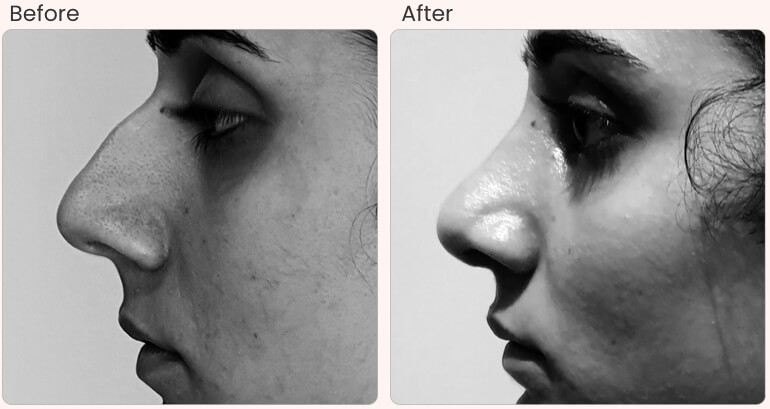
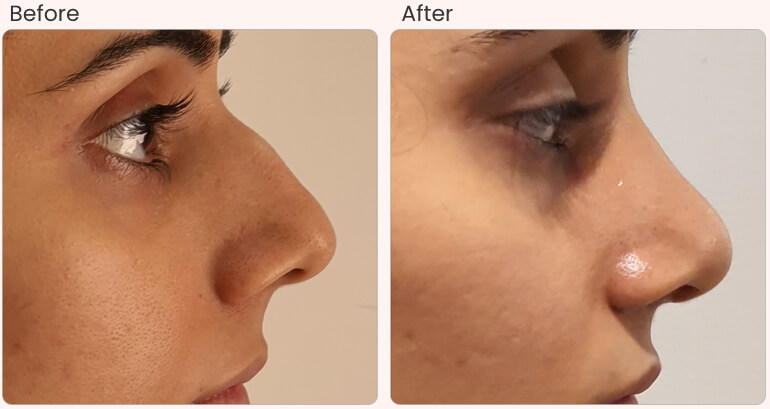
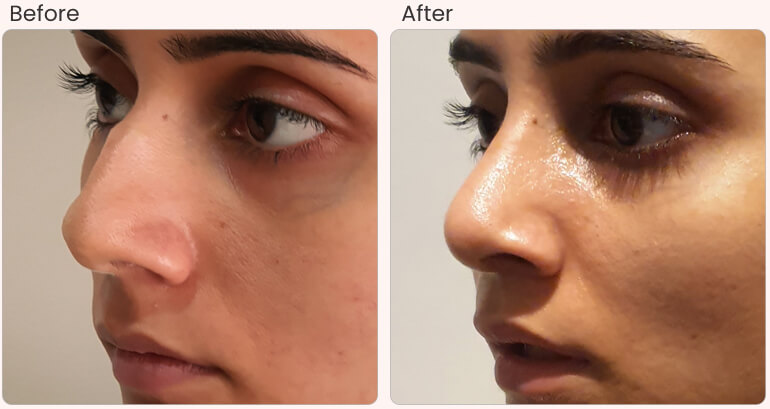
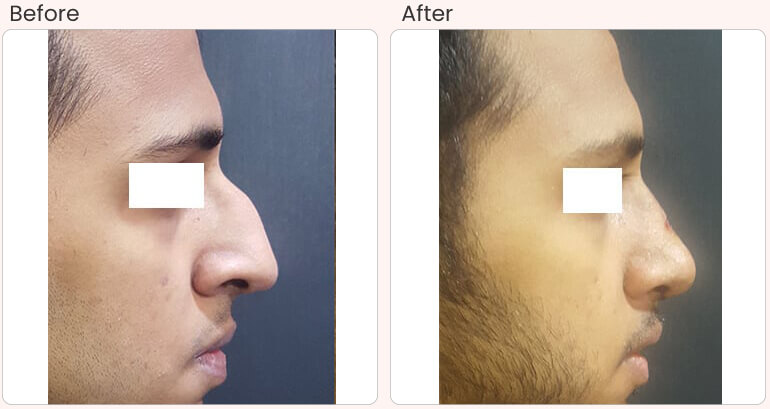
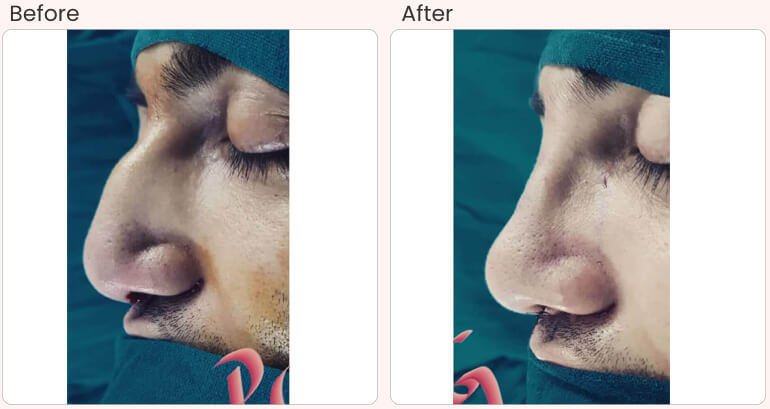
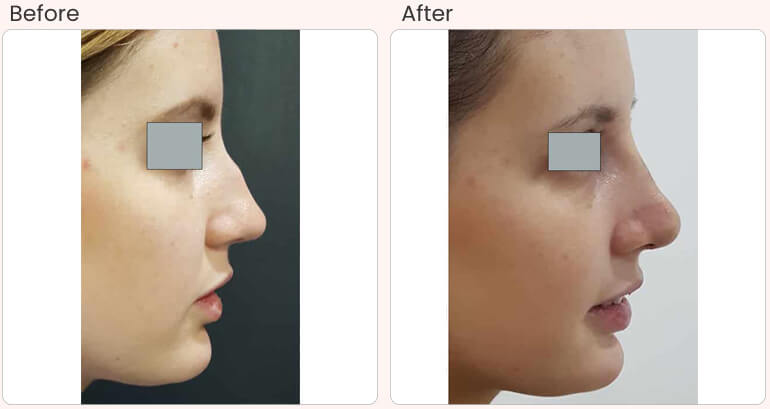
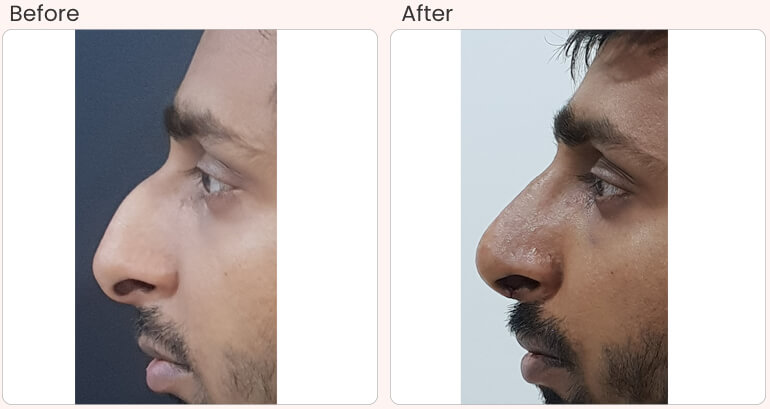
Rhinoplasty Surgery Best Results / Before & After

Our patient came to us feeling self conscious about her nose, describing it as blunt and wide. She expressed a clear desire for a sharper, more refined look but with one crucial condition: it had to appear completely natural. Our patient got a new, balanced nose, which enhanced her features without drawing attention to the fact that she had undergone surgery


A NOTE ON PHILOSOPHY
A Note on What Rhinoplasty Is, and What It Is Not
Rhinoplasty is not about creating a different face. It is about better balance within the face you already have.
Does rhinoplasty change how you look? Yes – but ideally in a subtle way. A successful result improves facial harmony without drawing attention to itself, and the best outcomes come from patients who want refinement rather than transformation. A nose that looks natural at 25 should still look natural at 45 and beyond.
This is why consultation matters so much. Decisions about tip refinement, hump reduction, bridge width, airway function, and surgical approach shape the result far more than the operation itself.
WHO IS A CANDIDATE
Who is a Candidate for Rhinoplasty?
Rhinoplasty is suitable for adults in good health who have realistic expectations and concerns relating to nasal appearance, breathing, or both.
Common reasons patients seek rhinoplasty surgery include:
Good Candidates
Not a Candidate
Patients frequently ask:
“What is the best age for rhinoplasty?”
Most rhinoplasty procedures are performed after nasal growth is complete, typically around 16–17 years for females and 17–18 years for males.
Approximately one in five consultations does not result in surgery. Sometimes the best recommendation is to wait, reconsider, or simply continue the conversation.
THE APPROACHES
Five Approaches, Matched to the Case
There is no single best technique. The right approach depends on your anatomy, goals, and functional needs – from closed rhinoplasty for smaller refinements to open, septorhinoplasty, ultrasonic Piezo, and revision for more complex cases. The table below summarizes each.
| Approach | Best Suited For | Profile |
|---|---|---|
| Closed Rhinoplasty | Smaller refinements, limited bone work | Incisions entirely inside the nostrils; no external scar. |
| Open Rhinoplasty | Complex tip work, revision, structural rebuilding | A small columellar incision gives direct view of the cartilage; the scar fades almost invisibly. |
| Septorhinoplasty | A deviated septum or breathing impairment | Combines refinement with functional correction; the functional part may be partly insured. |
| Ultrasonic Rhinoplasty (Piezo) | Bone work – hump reduction, bridge narrowing | Ultrasonic vibrations reshape bone with minimal trauma, reducing bruising and shortening recovery. |
| Revision Rhinoplasty | Dissatisfaction with a previous result | More complex; usually 12+ months after the original, often needing ear or rib cartilage grafts. |
When Rhinoplasty Is Combined With Chin Augmentation
The nose and chin work together to create facial balance; a weak chin can make the nose look larger than it is. Chin augmentation may occasionally be discussed during a rhinoplasty consultation – not to add surgery unnecessarily, but to assess the face as a whole and recommend only what is genuinely needed.
Don't take biggest decision of life
Without getting complete information!
A NOTE ON PUBLISHED RESEARCH
Published Research on Nasal Grafting
Patients searching for a board-certified rhinoplasty surgeon often focus on before-and-after photographs. Equally important is the surgeon’s contribution to the scientific literature.
Composite Grafts for Alar and Columellar Defects
- Revision rhinoplasty cases.
- Reconstructive rhinoplasty after trauma.
- Nasal reconstruction following skin cancer surgery.
- Complex grafting procedures requiring structural support.
What the Procedure Involves
Patients considering rhinoplasty surgery often ask what happens during the operation.
General anaesthesia with full pre-operative assessment.
Most procedures take 1 to 2 hours; revision often needs more time.
Open, closed, septorhinoplasty, or ultrasonic Piezo, depending on your anatomy and goals.
Cartilage may be taken from the nasal septum, ear, or rib when extra support or reshaping is required.
An external nasal splint is usually worn for about one week.
Most patients go home the same day, from an accredited facility with full anaesthetic monitoring.
Recovery: A Realistic Timeline
One of the most common questions is:
“How long does rhinoplasty take to heal?”
Swelling and bruising around the eyes and nose are expected; an external splint stays in place, and sleeping with the head elevated helps.
The splint is removed at a follow-up visit, and most bruising begins to fade. Patients can usually return to work
Most patients resume social activities.
Exercise may resume gradually. Contact sports and heavy activities remain restricted.
About 70 to 80% of swelling resolves and tip definition improves.
Final refinements appear; the complete result often takes up to a year.
Structured follow-up appointments are scheduled throughout recovery.
RISKS AND HONEST DISCLOSURE
Risks: An Honest Disclosure
Performed by an experienced, board-certified surgeon, rhinoplasty is generally safe – but every operation carries risk.
- General: bleeding, infection, delayed wound healing, and anaesthetic complications.
- Rhinoplasty-specific: persistent swelling, minor asymmetry, breathing changes, temporary numbness, and contour irregularities.
- Revision: rhinoplasty has a higher revision rate than many cosmetic procedures; international studies suggest about 5 to 10% of patients may benefit from a minor revision.
- Cartilage grafts: a small donor-site scar and a very low risk of graft resorption or warping.
A personalised discussion of risks forms part of every consultation and consent process.
Don't take biggest decision of life
Without getting complete information!
Transparent Pricing
What Rhinoplasty Surgery Costs?
Cost depends on the complexity of the case, the surgical approach, and whether cartilage grafting or functional correction is required.
What Influences Cost?
- Open vs closed rhinoplasty approach.
- Primary versus revision rhinoplasty.
- Use of ultrasonic piezo technology.
- Cartilage graft requirements.
- Functional septorhinoplasty correction.
- Surgical and anaesthetic duration.
WHY THIS PRACTICE
Why Patients Choose This Practice for Rhinoplasty Surgery?
Choosing a board-certified rhinoplasty surgeon is one of the most important decisions in the rhinoplasty journey.
Patients choose Dr Rajat Gupta because of:
- International fellowship training in cosmetic surgery (Instituto de Benito, Barcelona).
- Expertise across five approaches – closed, open, septorhinoplasty, ultrasonic Piezo, and revision – including advanced Piezo technology for precise bone reshaping with less bruising.
- Peer-published research on nasal grafting and reconstructive rhinoplasty.
- Experience with both cosmetic and functional concerns, including deviated-septum correction.
- A consultation where surgery is recommended only when genuinely appropriate, with a written surgical plan covering technique, results, recovery, risks, and cost.
- An ISAPS-accredited training centre, with structured follow-up through the full first year.
Common Questions
Common Questions About Rhinoplasty
Typically INR 1,75,000 to 6,50,000, depending on technique and complexity. Revision and septorhinoplasty generally cost more due to the additional expertise required.
Usually moderate discomfort rather than severe pain – pressure, congestion, and swelling in the first week, improving markedly after splint removal.
Most patients return to work within 7 to 14 days. Visible swelling improves over weeks, while the final result refines for up to 12 months.
Closed rhinoplasty leaves none. Open rhinoplasty uses a small incision beneath the nose that typically heals very well and becomes hard to detect.
Yes. Septorhinoplasty combines cosmetic reshaping with correction of a deviated septum or airway problem, improving both appearance and breathing.
Closed places all incisions inside the nostrils, for selected cases. Open gives greater visibility and precision for complex tip work, revision, and reconstruction.
It uses ultrasonic technology to reshape nasal bones precisely with less trauma to surrounding tissue, often meaning less bruising and faster recovery.
Usually after nasal growth is complete, from about 16 to 18 onwards. There is no strict upper limit if you are healthy enough for surgery.
Yes; the structural changes are considered permanent, though natural ageing continues to affect facial tissues over time.
A good result looks natural and balanced with the rest of the face. The goal is refinement, not an obvious surgical look.
Temporary numbness around the tip is common and usually resolves gradually over several months as healing progresses.
THE FIRST CONSULTATION
What to Expect at Your First Consultation?
- A consultation lasts 30 to 45 minutes and includes a discussion of your concerns and goals;
- External and internal nasal examination.
- Assessment of breathing function and septal deviation.
- Standardised clinical photography.
- 3D simulation where appropriate.
- A discussion of open, closed, septorhinoplasty, ultrasonic piezo, or revision options.
- Honest guidance on what surgery can realistically achieve.
- A review of recovery, risks, and long-term expectations.
- A detailed written cost estimate.
- You are encouraged to take time before deciding, and if surgery is not the right option, that will be said openly.
Book a Considered Consultation
A consultation with Dr Gupta is the beginning of a conversation, not a transaction.