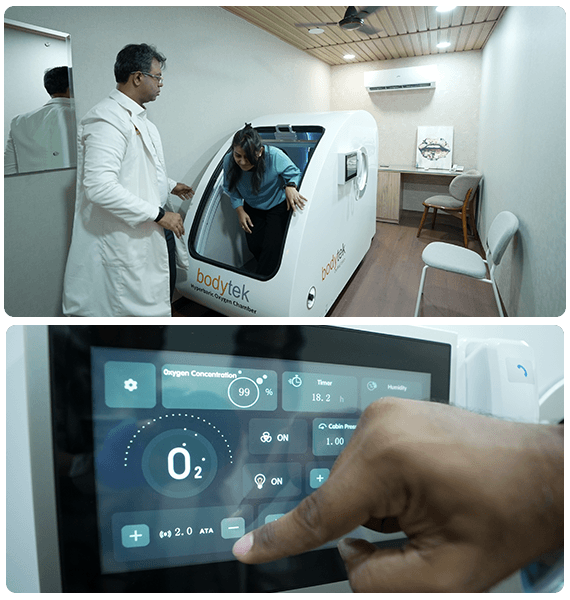
The First on-site Hyperbaric Oxygen Chamber at an Indian Plastic Surgery Centre.
Less Swelling. Less Bruising. Faster Healing.
Under the medical supervision of Dr Rajat Gupta, MBBS, MS, DNB (Plastic Surgery)
Board-Certified Plastic Surgeon · ISAPS Accredited Training Centre · PURE Contouring Trademark · SHARP Abdominoplasty (ASJ Open Forum 2025)
At RG Aesthetics, HBOT for cosmetic surgery recovery is not an add-on from a nearby wellness centre. It is a fully integrated part of our surgical practice, delivered in a medical-grade hyperbaric oxygen chamber installed on our premises. We are the first plastic surgery centre in India to make this investment. Faster recovery. Less swelling. Better wound healing. Fewer complications. This is what modern cosmetic surgery aftercare should look like.

What Is HBOT and How Does It Work?
HBOT (Hyperbaric Oxygen Therapy) delivers 100% pure oxygen inside a sealed chamber pressurised to 2.0 to 2.4 times normal atmospheric pressure. The combination dissolves dramatically more oxygen into your blood plasma, reaching tissues that normal breathing cannot fully oxygenate.
The HBOT Science, in Four Points
- Henry’s Law: gas dissolved in a liquid is proportional to pressure. Doubling pressure roughly triples dissolved plasma oxygen.
- Dissolved Oxygen Rises 10 to 15 Times: under HBOT pressure, oxygen reaches tissues that haemoglobin alone cannot fully supply, including swollen post-surgical zones.
- Vasoconstriction Reduces Fluid Leak: the pressure narrows small blood vessels, physically reducing the leakage that produces post-surgical swelling and edema.
- Oxygen Delivery Continues Despite Vasoconstriction: dissolved plasma oxygen bypasses the narrowed vessels, so tissues stay oxygenated. This dual action is unique to HBOT.
How HBOT Speeds Recovery After Cosmetic Surgery
Five biological mechanisms work in parallel during the recovery window:
- Reduced Swelling and Edema: pressure-driven vasoconstriction plus increased tissue oxygenation directly reduces post-operative swelling, meaningfully improving comfort in the first two weeks.
- Accelerated Wound Healing: increased oxygen drives faster fibroblast proliferation, collagen synthesis, and epithelial closure. Documented across 296 patients in the Aguilar et al. 2024 study.
- Reduced Bruising: the Jacono 2010 study in Archives of Facial Plastic Surgery documented a 35 % reduction in visible bruising at day 7 after facelift.
- Enhanced Antimicrobial Activity: elevated tissue oxygen supports the immune response at surgical sites. Aguilar 2024 series reported zero surgical site infections across 296 patients.
- Better Scar Quality: supports fibroblast activity and collagen organisation, producing finer scars at the 6 and 12-month
Which Cosmetic Procedures Benefit Most From HBOT?
High-Risk and Compromised Healing
- Best For: smokers, diabetics, patients with previous wound-healing difficulty, revision surgery, immunosuppressed patients.
- Typical Protocol: personalised, often including pre-operative sessions to optimise baseline tissue oxygenation.
- Key Benefit: meaningfully reduced complication risk in cases where healing would otherwise be compromised.

Our HBOT Protocol at RG Aesthetics
Session Structure
- Duration: 45 to 60 minutes at 2.0 to 2.4 ATA.
- Frequency: 3 to 4 sessions during the first week after surgery.
- First Session: 24 to 48 hours post-surgery, once cleared by the
- Supervision: Every session is supervised by a trained hyperbaric technician/nurse with a doctor on call.
The Research Behind HBOT in Aesthetic Surgery
Three published citations form the evidence base for our protocol:
- Aguilar et al. 2024: Plastic and Reconstructive Surgery Global Open. 296 aesthetic surgery patients. Faster return-to-work across procedures. Zero surgical site infections. Zero tissue necrosis. Overall complication rate 10.7%.
- Jacono et al. 2010: Archives of Facial Plastic Surgery. Randomised study of perioperative HBOT in facelift surgery. 35% reduction in visible bruising at day 7.
- Ongoing Reconstructive Surgery Research: documents HBOT’s role in flap survival across DIEP breast reconstruction and complex head and neck cases. Informs our reconstructive protocols.
Why We Are the First Plastic Surgery Centre in India With HBOT
Hyperbaric oxygen chambers exist in India at standalone hyperbaric facilities, hospital wound care departments, and some wellness clinics. What has not existed until now is an HBOT chamber installed inside a plastic surgery practice, dedicated to cosmetic and reconstructive recovery, integrated with the surgical journey rather than delivered as a wellness add-on.
Sending post-operative patients across the city to a separate facility during the vulnerable first week is meaningfully harder than it needs to be. Bringing the chamber into the practice was the logical clinical answer. It reflects how we think about surgery in general: use every tool the evidence supports, refine protocols with data, and give patients the best chance at a smooth, safe recovery.
Chamber Specifications and Safety Standards for HBOT
- Type: monoplace hard-shell medical-grade hyperbaric oxygen chamber.
- Construction: certified pressure-rated clear acrylic with machined metal end caps.
- Visibility: clear acrylic allows patient to see the room and technician to maintain visual contact.
- Working Pressure: 0 to 2.4 ATA (therapeutic range for cosmetic surgery recovery).
- Certified Rating: up to 3.0 ATA, providing safety headroom above operating pressure.
- Not Equivalent To: soft-shell ‘mild’ wellness chambers (1.3 to 1.5 ATA) which do not deliver medical-grade 100% oxygen.
- ASME PVHO-1: American Society of Mechanical Engineers Pressure Vessels for Human Occupancy standard.
- NFPA 99 Chapter 14: National Fire Protection Association standard for hyperbaric facilities in healthcare settings.
- UHMS Engineering Guidelines: Undersea and Hyperbaric Medical Society standards for clinical HBOT delivery.
- Patient Call Button: immediate technician communication.
- Two-Way Voice: continuous conversation without leaving the chamber.
- Auxiliary Audio: personal music or audio content during sessions.
- Wedge Cushion and Pillow: comfort and correct positioning.
- Gas Selection Panel: precise oxygen and air-break protocol management.
- Air-Break System: ambient air delivery during longer sessions.
- Emergency Depressurisation: immediate pressure release at any time.
HBOT Session Costs in India and What to Expect
HBOT costs are quoted individually as part of your surgical plan rather than published as a flat rate. What determines your cost:
- Number of Sessions: 3 to 10 depending on procedure. Complex reconstructive cases require more.
- Pre-Operative Sessions: included for high-risk patients (smokers, diabetics, prior wound-healing difficulty).
- Session Duration: 45 to 90 minutes depending on procedure protocol.
- Integration With Surgery: bundled into your surgical estimate, not a standalone add-on.
Is HBOT Cost Covered Under Insurance?
- Cosmetic Surgery HBOT: Generally not covered by Indian health insurance.
- Reconstructive Surgery HBOT: May be partially covered where the reconstruction itself is covered. We help you check during consultation.
- Medical HBOT: Separate coverage rules apply for wound care, diabetic foot, and radiation injury indications.
Safety and Contraindications
HBOT has a strong safety record in properly specified chambers under trained supervision. Aguilar 2024 reported zero surgical site infections and zero tissue necrosis across 296 patients.
Common Minor Side Effects (Self-Resolving)
- Ear Pressure: Similar to aeroplane descent. Managed with pressure-equalisation techniques taught at your first session.
- Temporary Near-Sightedness: A small subset of patients. Resolves within weeks of finishing treatment.
- Mild Claustrophobia: Reduced by the clear acrylic chamber design allowing continuous visual contact.
Absolute Contraindications
- Untreated Pneumothorax: Pressure change poses genuine risk.
- Certain Rare Lung Conditions: Assessed individually.
- Active Uncontrolled Seizure Disorder: Assessed with neurology input if relevant.
- Recent Ear Surgery: Requires case-by-case evaluation.
Relative Contraindications (Assessed Individually)
- Managed, Not Absolute: Poorly controlled diabetes, heart failure, active infection, high fever, claustrophobia. Each evaluated during consultation.
Common Questions
Frequently Asked Questions About HBOT in India
HBOT stands for Hyperbaric Oxygen Therapy. It is a medical treatment in which the patient breathes 100% pure oxygen inside a sealed chamber pressurised to 2.0 to 2.4 times normal atmospheric pressure. The combination dissolves significantly more oxygen into blood plasma, supporting faster healing, reduced swelling, better wound closure, and lower complication rates after surgery.
HBOT stands for Hyperbaric Oxygen Therapy. Hyperbaric comes from Greek roots meaning high pressure (hyper for above, baric for pressure). Oxygen Therapy refers to the therapeutic use of oxygen. Together, HBOT means the medical use of pure oxygen delivered under higher than normal atmospheric pressure inside a sealed chamber.
HBOT works through two mechanisms. The pressure causes controlled narrowing of small blood vessels, which reduces the fluid leakage that produces swelling. Simultaneously, the dissolved oxygen delivered under pressure reaches tissues that normal breathing cannot fully oxygenate, supporting wound healing, collagen production, and immune function during the recovery window.
Yes, supported by published research. The Aguilar 2024 study of 296 aesthetic surgery patients showed faster return-to-work times across procedures. The Jacono 2010 study documented a 35% reduction in bruising at day 7 after facelift. Both studies were published in peer-reviewed plastic surgery journals and inform current recovery protocols internationally.
The number of sessions is procedure and patient-specific . Rhinoplasty and facelift typically use 3 to 5 sessions. Tummy tuck and complex abdominoplasty use 6 to 8 , sometimes with pre-operative sessions. Your exact protocol is determined during consultation.
Each HBOT session at RG Aesthetics lasts 45 to 60 minutes at 2.0 to 2.4 ATA, with the exact duration determined by your specific protocol. Total time in the clinic, including preparation and post-session monitoring, is typically 90 minutes to 2 hours.
HBOT typically starts within 24 to 48 hours after surgery, once you are stable and cleared by your surgeon. For flap-based reconstructive procedures, early HBOT is particularly valuable for supporting flap survival during the vulnerable first several days.
No. HBOT itself is entirely painless. The most common physical sensation during a session is mild ear pressure similar to that felt during aeroplane descent, managed easily with pressure-equalisation techniques taught at the start of your first session. Most patients report the sessions as relaxing rather than uncomfortable, and many use them to rest, listen to music, or sleep.
Yes, when delivered in a medical-grade chamber under trained supervision. The Aguilar 2024 series reported zero surgical site infections and zero tissue necrosis across 296 patients, with an overall complication rate of only 10.7% consisting primarily of minor issues. Patients are screened for contraindications before their first session, and every session is supervised.
The clear acrylic chamber at RG Aesthetics is deliberately designed to reduce claustrophobia by allowing continuous visual contact with the room and the supervising technician. Most patients with mild claustrophobia manage the sessions well. Patients with severe claustrophobia are assessed individually during consultation; sometimes a trial session with medical support is arranged first.
The HBOT chamber is installed on-site at RG Aesthetics, our plastic surgery practice located at 56 Block BN, Poorbi Shalimar Bag, Shalimar Bagh, Delhi 110088. Being on-site means that patients recovering from surgery do not need to travel to a separate facility for their sessions during the vulnerable first week, a meaningful practical advantage over off-site HBOT arrangements.
HBOT is discussed as part of your surgical consultation with Dr Gupta. If HBOT would meaningfully improve your recovery, we will recommend it and include it in your surgical plan and written estimate. If it would not add meaningful value for your specific case, we will tell you that too. Book a consultation to discuss whether HBOT is right for your planned procedure.
Recover Faster . Swell Less . Heal Better
If you are planning cosmetic surgery and want to know how HBOT could shorten your recovery, book a consultation. As one of the best plastic surgery practices in Delhi, RG Aesthetics combines the published SHARP, OCCULT, and PURE Contouring techniques with the first on-site HBOT programme at any Indian plastic surgery centre. Better surgery and faster recovery, planned together, with the same team through both phases.
Your consultation includes a clinical examination, honest discussion of surgical options, a recommended recovery protocol, and a written estimate. If HBOT is right for your case, we will explain why. If not, we will tell you that too.