
When patients search for facelift surgery, they often want to know exactly what happens in the operation theatre. The facelift procedure in Delhi with Dr Rajat Gupta is a carefully planned, multi-stage process that focuses on safety, precision, and natural looking rejuvenation.
Pre-surgery Assessment and Planning
The procedure starts well before the actual facelift surgery day. During consultation, Dr Gupta:
- Examines facial skin, muscles, fat pads, and neck contour
- Reviews medical history, medications, and lifestyle factors
- Uses photographs and sometimes 3D simulation to plan lift vectors and incision placement
Together with the patient, he decides whether a mini facelift, SMAS facelift, or deep plane facelift will provide the best outcome. This stage ensures the facelift surgery step by step plan is tailored to each face, not a one-style-fits-all approach.
Have questions or want to get started? We are ready to help you with a smile!
Marking and Preparation on Surgery Day
Now let’s understand how facelift surgery is done. On the day of surgery, detailed skin markings are done in an upright position. These markings guide:
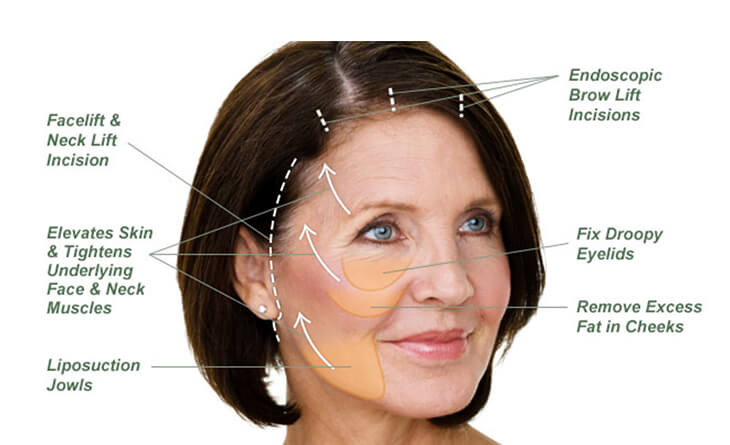
- Incision lines around the hairline and natural creases near the ear
- Direction of tissue lifting
- Areas of skin that will be redraped or removed
You are then taken to the operating room, where monitors are attached for heart rate, blood pressure, and oxygen. An anaesthetist administers general or local anaesthesia with sedation, so you remain comfortable throughout the facelift procedure in Delhi.
Step by Step: How Facelift Surgery Is Done
Once anaesthesia takes effect, the facelift surgery steps begin:
- Incisions: Tiny, well-hidden incisions are made along the hairline and around the ear. For neck work, an additional short incision may be used under the chin.
- SMAS or Deep Plane Access: The deeper layer called the SMAS (superficial musculoaponeurotic system) is lifted. In a deep plane facelift, muscle and fat layers are repositioned together for highly natural movement.
- Tissue Lifting and Fixation: The tissues are gently mobilised and lifted in an upward and backward direction, correcting jowls, sagging cheeks, and neck laxity. Sutures anchor these layers securely so that the result lasts many years.
- Skin Redraping: The skin is smoothed over the new contour without tension. Excess skin is trimmed carefully to avoid a “pulled” or artificial look.
- Closure: Fine sutures close the incisions. Dr Gupta aligns the skin edges precisely so that scars heal thin and fade into natural creases.
Throughout the facelift surgery step by step process, meticulous haemostasis is maintained to reduce bruising and swelling.
Immediately After Facelift Surgery
After the facelift surgical steps are completed, a light dressing or compression bandage is applied around the face and sometimes the neck. This supports the new contours and reduces fluid collection.
You are moved to a facelift surgery anaesthesia recovery room where nurses monitor your vitals as you wake up. Mild tightness or heaviness around the cheeks and neck is normal at this stage. Pain is usually minimal and controlled with medication.
Most patients stay for a few hours of observation and are discharged the same day or after an overnight stay, depending on the extent of the facelift procedure in Delhi.
Early Recovery and Follow Up
In the first week:
- Swelling and mild bruising appear, especially around the lower face and neck
- Head elevation and cold compresses help speed recovery
- Stitches are removed within 7 to 10 days, if not dissolvable
By two weeks, most people feel comfortable returning to social or office work. The deeper tissues continue to settle over the next few months, revealing the final, natural result.
Regular follow ups allow Dr Gupta to check healing, guide skincare, and ensure that the facelift operation process has delivered smooth, balanced contours that look like a younger version of you, not a different person.
FAQs About Facelift Surgery Procedure
Most facelift surgeries take 2 to 4 hours depending on whether the SMAS layer or deep plane is being lifted. Combined procedures like neck lift can extend the time.
Incisions are hidden around the ear and hairline, and when closed carefully, they fade extremely well. Most patients find them almost invisible within a few months.
Drains are rarely used today because modern facelift techniques minimize bleeding. When used, they are removed within 24–48 hours.
Generally after 2 to 3 days, once the bandage is removed. Gentle washing is recommended to avoid pulling on sutures.
Most patients describe it as tightness rather than pain. Discomfort is easily managed with medication for the first few days.
Initial swelling settles in 2–3 weeks, but the final refined contour may take 2–3 months to fully appear.

Dr. Rajat Gupta
MBBS, MS, DNB(Gen. Surg.),
DNB (Plastic Surgery)
Dr. Rajat Gupta is a board certified plastic surgeon in India with 18+ years of experience to back his expertise in the domain of aesthetic surgeries.
Having completed his training from Maulana Azad Medical College and equipped with a thorough understanding of aesthetic needs of people, Dr. Gupta strives to offer the best remedies and cosmetic procedures outfitted with the latest technology to the aspirants in India and across the globe. To book an appointment, call: +91-9251711711 or email: [email protected]