Hooded Eyes Surgery: Is It Blepharoplasty, a Brow Lift or Both?
Hooded eyes surgery depends on the cause of the hooding. Excess eyelid skin is treated with upper blepharoplasty, a low brow with a brow lift or brow pexy, and some people need both. True lid drooping, called ptosis, needs a different operation.
Updated 26 Oct 2026
Key takeaways
- The operation follows the cause: upper blepharoplasty for loose lid skin, a brow lift or brow pexy for a low brow, ptosis repair for a low lid edge, and sometimes a combination.
- Operating on the eyelids alone can leave a low brow looking lower, so brow position needs to be assessed as part of the examination.
- A mirror check can point you in a direction but cannot diagnose. An examination does.
- Mild hooding may respond to non-surgical treatment, which does not remove excess skin.
In this article
- 1Which hooded eyes surgery fits which cause of hooding?
- 2The cause-finder table
- 3Red flags that change the plan
- 4What does upper blepharoplasty do for hooded eyes, and what can't it do?
- 5When is a low brow the real cause, and what is a brow lift or brow pexy?
- 6Is a drooping eyelid (ptosis) the same as hooded eyes?
- 7Can a mirror check tell you whether you need a brow lift?
- 8How does a surgeon assess lid and brow position before hooded eye surgery?
- 9What the examination covers
- 10How Dr Gupta approaches it at RG Aesthetics
- 11What to bring and ask
- 12When are a brow lift and blepharoplasty combined, and why can eyelid-only surgery expose a low brow?
- 13What the evidence shows
- 14How Dr Gupta uses brow pexy
- 15If your concern extends beyond the upper face
- 16How to fix hooded eyes without surgery, and when it isn't enough
- 17What are the risks of eyelid surgery, and what should you expect?
- 18Can you have a video consultation if you live outside Delhi or abroad?
- 19Which operation is right for your hooded eyes?
- 20Frequently asked questions
Two people can have the same heavy-lidded look for opposite reasons. In one, loose skin hangs over the lashes. In the other, the eyebrow has slipped down and is pressing skin onto the lid. The two problems need different operations, and choosing the wrong one can leave the problem in place.
Eyelid surgery is now very common. The International Society of Aesthetic Plastic Surgery (ISAPS) Global Survey 2024 ranked it as the most common surgical procedure for the first time, at more than 2.1 million procedures. That count covers every reason for eyelid surgery. It says nothing about whether your hooding is a skin problem, a brow problem or both.
This page shows how the cause is identified, in the order a surgeon works through it. It includes a table you can use before any consultation, a mirror check with three things to look for, and a checklist for your appointment. It also explains how a video consultation fits in if you live outside Delhi.
Which hooded eyes surgery fits which cause of hooding?
Hooded eyes have four common causes, and each points to a different operation: loose lid skin, a low brow, a low lid edge (true ptosis), or a change in fat or volume. "Hooded" describes how the eye looks. It is not a diagnosis.
Ageing, loss of skin elasticity and rapid weight loss can all contribute. Genetics and eye shape can also cause hooding in younger people, according to the American Society of Plastic Surgeons (ASPS).
The cause-finder table
| Cause | What you may notice | How it is assessed | Which operation addresses it |
|---|---|---|---|
| Excess eyelid skin (dermatochalasis: loose, redundant lid skin) | A fold of skin hangs over the lash line, may hide the natural crease and can make the lid feel heavy | The skin fold is measured with the brow held at a natural height. If the fold remains, skin is a main cause | Upper blepharoplasty |
| Low brow (brow ptosis) | Brow hair sits at or below the bony rim above the eye. Hooding eases when the brow is steadied. The forehead may tire | Brow position is noted with the forehead muscle relaxed, then the brow is lifted gently by the examiner | Brow lift or brow pexy, often alongside blepharoplasty |
| True ptosis (low lid edge) | The edge of the upper lid itself sits lower than usual, may cover more of the coloured part of the eye (the iris) than on the other side, and may differ between the two eyes | Lid-edge position relative to the pupil and the strength of the lid-lifting muscle (levator) are measured | Ptosis repair, which works on the structures that lift the lid, not on skin |
| Fat or volume change | Fuller upper lids from fat that has pushed forward, or a hollowed, sagging look around the brow and lid | Judged at examination, together with the skin and brow findings | Fat that has pushed forward may be sculpted during upper blepharoplasty; hollowing may be treated with fat grafting |
The first three rows are separated by the same examination: where the brow sits, how much skin remains when the brow is steadied, and where the lid edge sits. The EyeWiki entry on dermatochalasis stresses that brow position and contour must be checked to tell true excess skin from a look created by a low brow.
Red flags that change the plan
Some conditions need attention before any hooded eyes surgery is planned. EyeWiki lists thyroid orbitopathy and chronic lid swelling among the risk factors for eyelid skin changes, and its pre-surgery history covers dry-eye symptoms and treatment. ASPS lists dry eyes as a possible effect of eyelid surgery. Tell your surgeon if any of these apply to you.
If your hooding comes from eye shape rather than loose skin or a low brow, for example a monolid or a low or absent crease, that is a different question, and the Asian blepharoplasty page covers it.
What does upper blepharoplasty do for hooded eyes, and what can't it do?
Upper blepharoplasty removes excess upper-lid skin and, where needed, a small amount of fat or muscle, usually through an incision hidden in the natural lid crease. It treats skin and fat. It does not lift a low brow or repair a low lid edge.
When loose skin is the main cause, a conservative upper blepharoplasty can open the eyes, as ASPS notes. The upper blepharoplasty page covers the operation itself in more detail.
The limits matter as much as the benefits:
- Removing more skin does not make up for a brow that sits too low. Over-correction is a recognised risk: EyeWiki lists lagophthalmos (incomplete lid closure), dry eye and over-correction among the complications.
- Lid skin is planned around the lid and the brow together. Surgeons document the crease height, symmetry and baseline photographs before surgery, because these show what was already present.
- A lid edge that sits low is not a skin problem, so skin removal cannot fix it.
When is a low brow the real cause, and what is a brow lift or brow pexy?
A low brow is the real cause when the brow has settled below its normal position and presses soft tissue down onto the lid. A brow lift raises the brow. A brow pexy (pexy means fixation) holds it at a higher position, sometimes through the eyelid crease incision.
The EyeWiki entry on brow ptosis and repair lists age-related soft-tissue descent as a cause of brow ptosis, with facial nerve palsy, neuromuscular conditions and masses as others.
The same source describes several routes to a higher brow: incisions above the brow, in a forehead crease, at or behind the hairline, or through the eyelid crease. Each leaves a scar in a different place and suits a different forehead, hairline and degree of lift. Which route suits a patient is decided at examination, not from a web page.
EyeWiki lists these risks for brow lifting: bleeding, numbness or tingling, infection, asymmetry and, rarely, facial nerve injury that causes paralytic brow ptosis. Some overlap with eyelid surgery.
Is a drooping eyelid (ptosis) the same as hooded eyes?
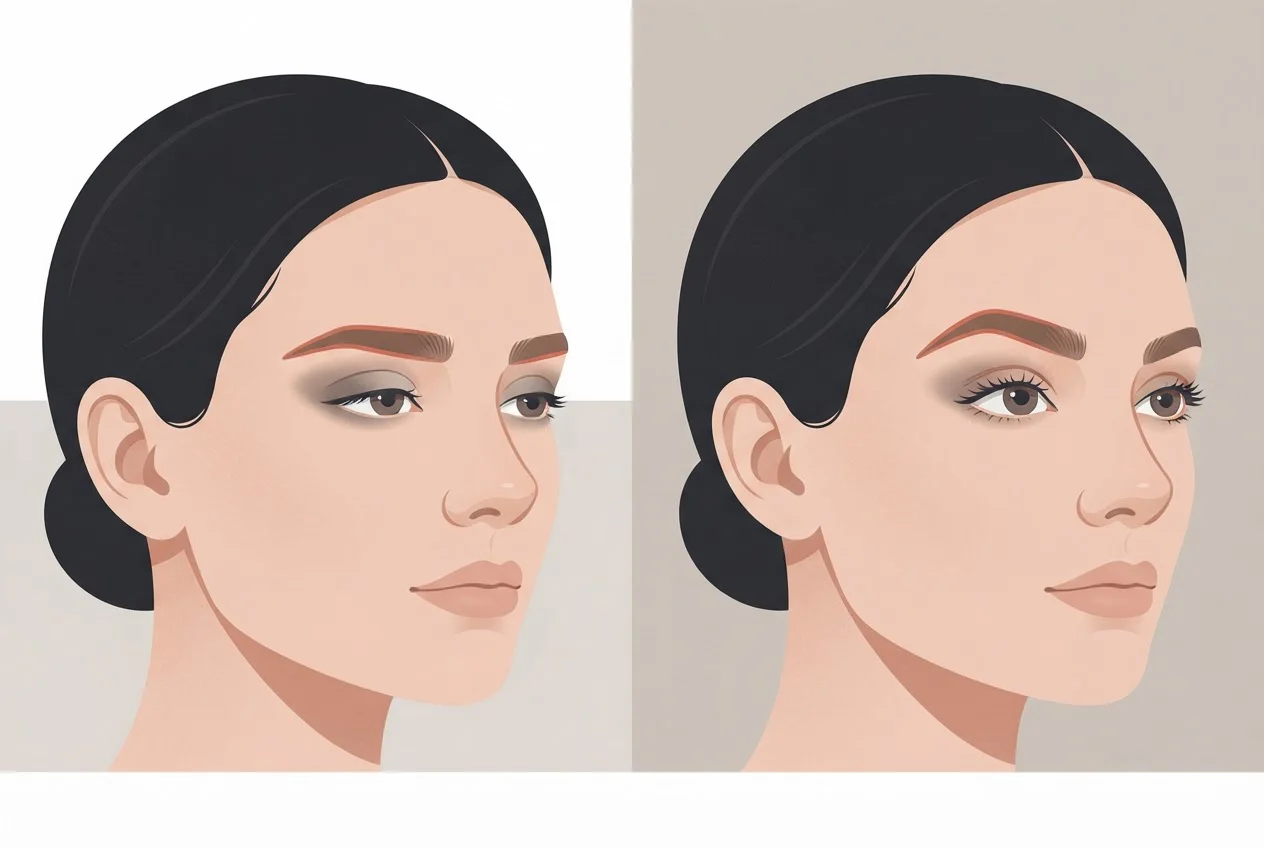
No. Hooded eyes describe an appearance, usually caused by skin or brow position. Ptosis (blepharoptosis) means the edge of the upper lid sits abnormally low because of the lid-lifting muscle or its tendon. The two can occur together, which is why the difference matters.
Surgeons measure ptosis as the distance from the light reflex on the pupil to the upper lid edge, called the marginal reflex distance. They also test the strength of the lid-lifting muscle. EyeWiki on blepharoptosis separates it from dermatochalasis, where the problem is skin rather than lid position. In older adults, the most common acquired type involves the tendon of the lid-lifting muscle.
Ptosis is treated with an operation on the lid-lifting muscle or its tendon, not by trimming skin.
Two points deserve attention:
- EyeWiki advises checking the opposite lid for masked ptosis (Hering phenomenon) when one lid is raised. This is another reason the lid edge is measured before surgery.
- Sudden drooping of an eyelid, or any change in vision, needs prompt medical review, according to NHS advice on eyelid problems.
Can a mirror check tell you whether you need a brow lift?
A mirror check can show whether the brow, the skin or the lid edge deserves a closer look. It cannot diagnose. Brow position has to be judged with the forehead muscle relaxed, and that is hard to do alone in a mirror.
EyeWiki states that brow position should be noted with the forehead muscle (the frontalis) relaxed. If you hold your brow up without noticing, the mirror misleads you. Try these steps in daylight, front-on:
- Relaxed browClose your eyes, relax the forehead, then open them without lifting your brows. Feel the bony rim above the eye socket. If the brow sits at or below it, a low brow is a possible contributor. If the brow sits clearly above the rim, brow position is less likely to be the main cause.
- Steady the browRest your fingertips on the bone above the brow and hold it at a natural height. Do not push it high. If the fold of skin largely disappears, the brow is likely doing much of the work. If a fold still hangs over the lash line, excess skin is likely a main cause.
- Lid edgeCompare the two eyes in a photo with the brow steadied. If one lid edge sits clearly lower than the other, or covers more of the coloured part of the eye (the iris) than on the other side, ptosis is possible. See a doctor and mention it.
The check cannot separate skin from fat or volume change. It cannot detect dry eye or thyroid-related eye disease, and pressing the brow too high gives a misleading result. Treat it as preparation for a consultation, not a substitute.
How does a surgeon assess lid and brow position before hooded eye surgery?
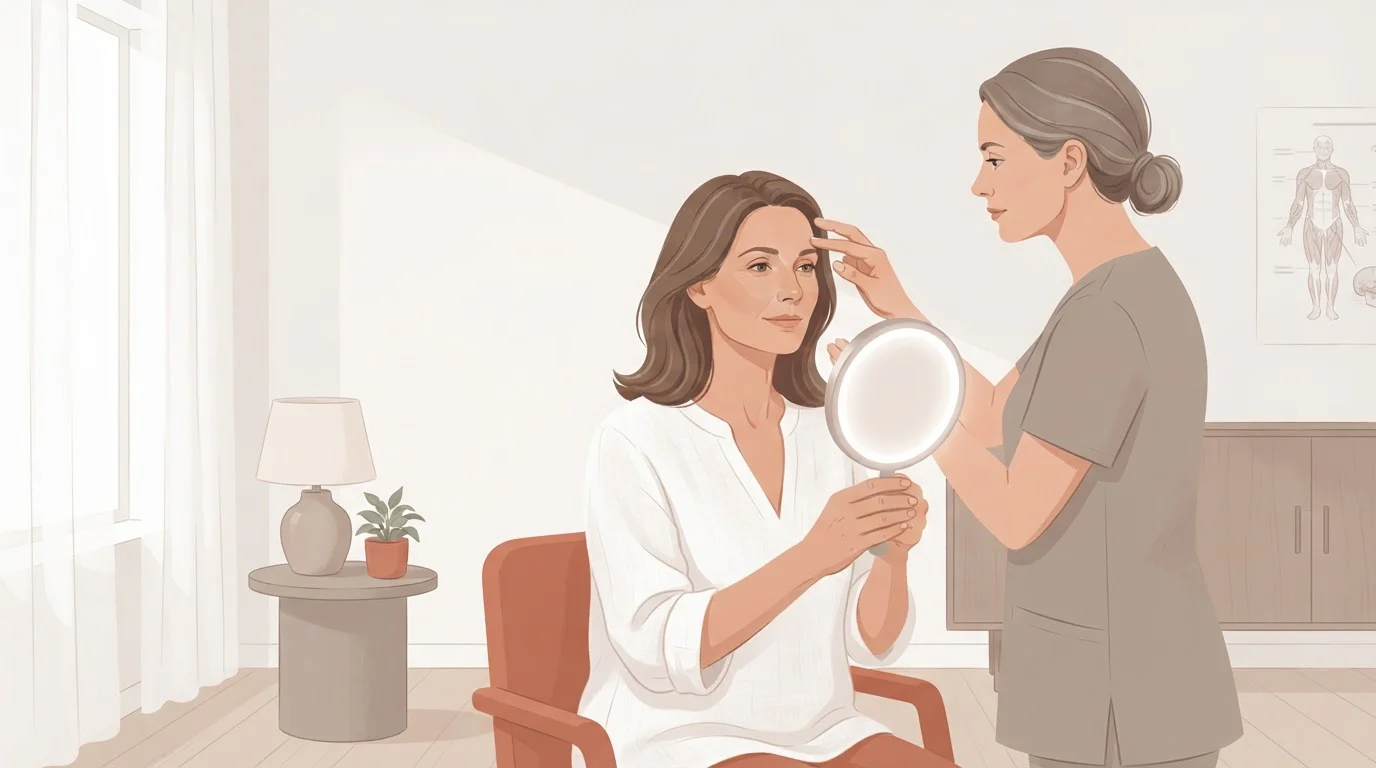
A surgeon's assessment covers the brow as well as the lids, because brow position changes how the eyelid looks. EyeWiki lists photographs, crease height and symmetry, lid-edge position, visual-field testing and manual lifting of the brow as parts of the examination.
What the examination covers
EyeWiki describes the standard steps. External photographs document the starting position. Crease height and symmetry are noted. The lid-edge distance and lid-lifting muscle function are measured to look for ptosis. Visual fields can be tested with the lids untaped and taped to show how much the lids block vision. The brow is noted at rest, then lifted manually to separate true excess skin from an effect of the brow.
EyeWiki advises that everyone considering blepharoplasty is evaluated for brow repositioning, with brow ptosis treated at the same time if needed. That way the lid skin is not planned around a brow that later changes position.
How Dr Gupta approaches it at RG Aesthetics
At RG Aesthetics in Delhi, Dr Rajat Gupta sees patients for an eyelid consultation lasting 45 to 60 minutes. It includes an examination of the eyelid skin, the distribution of fat and the health of the eyes. Dr Gupta discusses whether surgery, non-surgical options or both suit you, and says so if surgery is not right for you. You leave with a written plan covering technique, expected outcome, risks, recovery, timeline and cost. The aim is honest answers, realistic expectations and a decision without pressure.
Brow position is part of that conversation, because it changes how much lid skin needs to come off.
What to bring and ask
Bring:
- Older photographs. One or two front-on photos taken with a relaxed face, with both eyes clearly visible and even lighting. They show how far the brow and lids have changed.
- Your history. Medicines, previous eye or eyelid surgery, dry eye, thyroid problems and contact lens use, written down so nothing is missed on the day.
- Your own mirror notes. A line each for what you saw with the relaxed brow, the steadied brow and the lid edge. If you pressed the brow too high or skipped a step, repeat the check in daylight.
Ask:
- Is my hooding mainly skin, brow position, lid edge or a mix?
- If you operated on the eyelids only, what would happen to my brow?
- Does anything, such as dry eye, need treating or testing first?
- What are my options without surgery, and what happens if I wait?
- Who reviews me after surgery, and when?
If you would like your lids and brow looked at together, you can book a consultation with the team.
When are a brow lift and blepharoplasty combined, and why can eyelid-only surgery expose a low brow?
They are combined when loose lid skin and a low brow both contribute to the hooding. Treating only the lids leaves the brow where it was, and the low brow may look more noticeable once the lid skin has changed.
What the evidence shows
EyeWiki states that brow position can worsen the changes on the upper lid, and advises that anyone considering blepharoplasty is evaluated for brow repositioning. A study of 70 patients published in the World Journal of Plastic Surgery in 2016 measured brow position before and after upper blepharoplasty. Brow position was unchanged in 46 patients (65.8%). The brow had dropped in 24 (34.2%): in 7 of 12 men and 17 of 58 women. Most of these drops were small: 15 were under 2 mm, 6 were between 2 and 4 mm, and 3 were over 4 mm. The authors recommended telling patients about this before surgery, particularly men and older patients. They suggested brow lifting or fixing the brow through the eyelid incision as ways to prevent it.
This is one small single-centre study. It does not tell you your own risk. An inference from it: a brow already sitting low is a reason to ask your surgeon about it directly.
How Dr Gupta uses brow pexy
The RG Aesthetics results gallery includes a 56-year-old patient treated with upper blepharoplasty with brow pexy, together with lower blepharoplasty and lateral canthopexy (a stitch-based support of the outer corner of the lower lid). It is a multi-area case, not a hooded-eyes-only result. It shows brow pexy alongside upper blepharoplasty in selected cases. Results vary, and whether your brow needs attention at all is decided at examination.
At RG Aesthetics, a brow lift can be done endoscopically through hidden hairline incisions, as described on the endoscopic forehead and brow lift page, and a brow pexy can be added through the eyelid crease incision in selected cases.
If your concern extends beyond the upper face
If your concern also includes the midface and jowls, see the guide to combining a facelift with eyelid surgery or the endoscopic facelift page.
How to fix hooded eyes without surgery, and when it isn't enough
Mild hooding may improve without surgery, but the options do not remove excess skin. ASPS describes two: neurotoxin (the muscle-relaxing injection often called botulinum toxin) injected into the brow to lift it, and dermal filler to replace volume lost with age.
Both act on brow position or volume, not on loose lid skin. They are temporary. They may suit you if the hooding is mild and mostly caused by a slightly low brow or by hollowing.
ASPS describes surgery as the next step when sagging skin impairs vision or when a more marked change is wanted. If your upper lid skin fold stays in place when the brow is steadied in the mirror check above, injections are unlikely to be enough on their own. A good consultation covers non-surgical options before surgery, and a recommendation not to operate is a legitimate outcome.
What are the risks of eyelid surgery, and what should you expect?
Eyelid surgery carries real risks as well as benefits. ASPS lists swelling and bruising, dryness, bleeding, possible need for revision surgery, difficulty closing the eyes and unfavourable scarring. It also notes that vision can change, sometimes permanently, and that blindness is very rare.
EyeWiki adds asymmetry, over-correction and under-correction, dry eye, incomplete lid closure and retrobulbar haematoma. That is bleeding behind the eye, and it is an emergency. The NHS describes uneven-looking eyes as an occasional effect, with a rare risk of bleeding into the eye socket. It also notes that some people need another operation if the effect was not what they wanted. Brow surgery has its own list, covered in the brow lift section above.
ASPS says most people look presentable in 10 to 14 days, with final healing taking a few months, and the NHS says most take about two weeks off work. These are general ranges, not a timeline for any one practice or patient. For what the operation involves step by step, see the upper blepharoplasty procedure page. Cost varies from case to case and is covered separately in how much blepharoplasty costs.
Dr Gupta's approach is to remove only what is needed. Too much correction can leave the eyes looking hollow or pulled, and too little may not change them enough. Reviews are scheduled at week 1, week 4 and month 3. These are to check healing and your concerns, not to promise a result.
Can you have a video consultation if you live outside Delhi or abroad?
Yes. Dr Gupta offers secure video consultations before you travel, so that patients from other cities or countries arrive in Delhi with a clear surgical plan. After surgery, remote support and remote follow-up are offered where an in-person review is not practical.
A video consultation lets you discuss your concern, your history and your goals with Dr Gupta, and decide whether travelling is worthwhile. The in-person examination makes the definitive assessment of brow position, lid edge and eye health. Video cannot replace it.
The page for international patients sets out how travel coordination works. Use the mirror check and the checklist above to prepare.
Which operation is right for your hooded eyes?
The next step is an examination, because only an examination can tell which cause, or combination of causes, applies to you. Loose lid skin, a low brow, a low lid edge and fat or volume change can look alike in the mirror, and they are treated differently. The mirror check and the checklist above are there to make that appointment more useful, not to replace it.
The consultation is a conversation about surgery, non-surgical options or both, and you decide with honest information and no pressure. Dr Rajat Gupta has 18+ years of experience in cosmetic and reconstructive surgery, and RG Aesthetics is an ISAPS-accredited training centre; his qualifications and training are on the About page.
If you would like your own examination, book a consultation, or start with a video consultation if you are travelling in.
Book a hooded eyes consultation with Dr Gupta
Frequently asked questions
Sources
- 1.ISAPS Global Survey 2024
- 2.ASPS: Surgical options for hooded eyes
- 3.ASPS: Eyelid surgery safety
- 4.ASPS: Eyelid surgery results
- 5.EyeWiki: Upper Eyelid Blepharoplasty
- 6.EyeWiki: Dermatochalasis
- 7.EyeWiki: Brow Ptosis and Repair
- 8.EyeWiki: Blepharoptosis
- 9.Hassanpour and Khajouei Kermani, Brow Ptosis after Upper Blepharoplasty: Findings in 70 Patients (World Journal of Plastic Surgery, 2016)
- 10.NHS: Eyelid surgery
- 11.NHS: Eyelid problems