
Breast Lift Scars: Anchor, Lollipop, Donut and How They Heal
Breast lift scars follow the pattern your degree of sagging needs: around the nipple, vertical, or anchor-shaped. They are permanent, redden early, and fade gradually, often over a year or more.
Updated 4 Nov 2026

Key takeaways
Pattern and trade-off: A lift leaves a permanent scar, and its length generally follows the correction needed. Mild sagging may need only a ring around the areola (the darker skin around the nipple). Moderate sagging adds a vertical line. The most severe adds a line along the breast crease (S2). A smaller scar can leave the lift incomplete.
Aftercare and warning signs: Protect the scar from sun and use silicone as your surgeon advises. Call your surgeon for the warning signs listed in the healing table below.
In this article
- 1Why do breast lift scars always happen, and are they permanent?
- 2Lollipop vs anchor: what do the four breast lift scar patterns look like?
- 3How is your pattern chosen, and when is the smaller scar the wrong choice?
- 4How long do lift scars take to fade, and what is normal at each stage?
- 5Why do some lift scars heal darker or thicker, and what changes on darker skin?
- 6How do you minimise scarring after a breast lift: what has evidence and what doesn't?
- 7When should you call your surgeon about a raised or keloid scar, a wound opening or uneven breasts?
- 8Can a poor scar be improved, and when?
- 9What should you ask at a mastopexy consultation, and what should you bring?
- 10What is the next step if you are worried about the scar?
- 11Frequently asked questions
Every breast lift (mastopexy) that moves the nipple and removes loose skin leaves a scar. The length of that scar generally follows how much correction the breast needs. That trade is the real decision, and it is easier to make well once you know what each pattern looks like and how a scar behaves over the first year or two.
The operation is common. The ISAPS Global Survey 2025, from the International Society of Aesthetic Plastic Surgery, estimated 1,143,862 breast lifts worldwide, the fourth most frequent surgical procedure that year, and 17,360 in India. Scar revision, a broader category, ranked second among India's surgical procedures at an estimated 61,880. "Scars fade" is true, but it is not enough to choose between a shorter scar and a stronger lift.
Below we set out the four incision patterns, how surgeons choose between them, what a healing scar looks like at each stage, and why some scars turn darker or thicker, particularly on darker skin. We finish with the questions to put to any surgeon before you book.
Why do breast lift scars always happen, and are they permanent?
A breast lift raises the breast by removing excess skin and repositioning breast tissue and the nipple. That needs an incision, so every effective lift leaves a scar. The lines are permanent, but they fade and improve significantly over time (S2).
Surgeons place incisions where they are least conspicuous: at the edge of the areola (the darker skin around the nipple), down the front of the breast, and in the crease beneath it. Careful tissue handling and suturing keep the lines fine. How a scar finally looks depends on surgical technique, on steps to prevent infection (nutrition, not smoking, hydration), and on any underlying medical conditions or genetic tendencies (S2).
The shorter the incision, the less skin can be removed through it. That is why lifts marketed with minimal visible scarring cover a narrower range of sagging, as the FAQ below explains. Our page on breast lift surgery describes the operation itself.
Lollipop vs anchor: what do the four breast lift scar patterns look like?
There are four patterns: crescent, donut (periareolar), lollipop (vertical) and anchor (inverted-T). Scar length rises broadly with the amount of sagging corrected (S2).
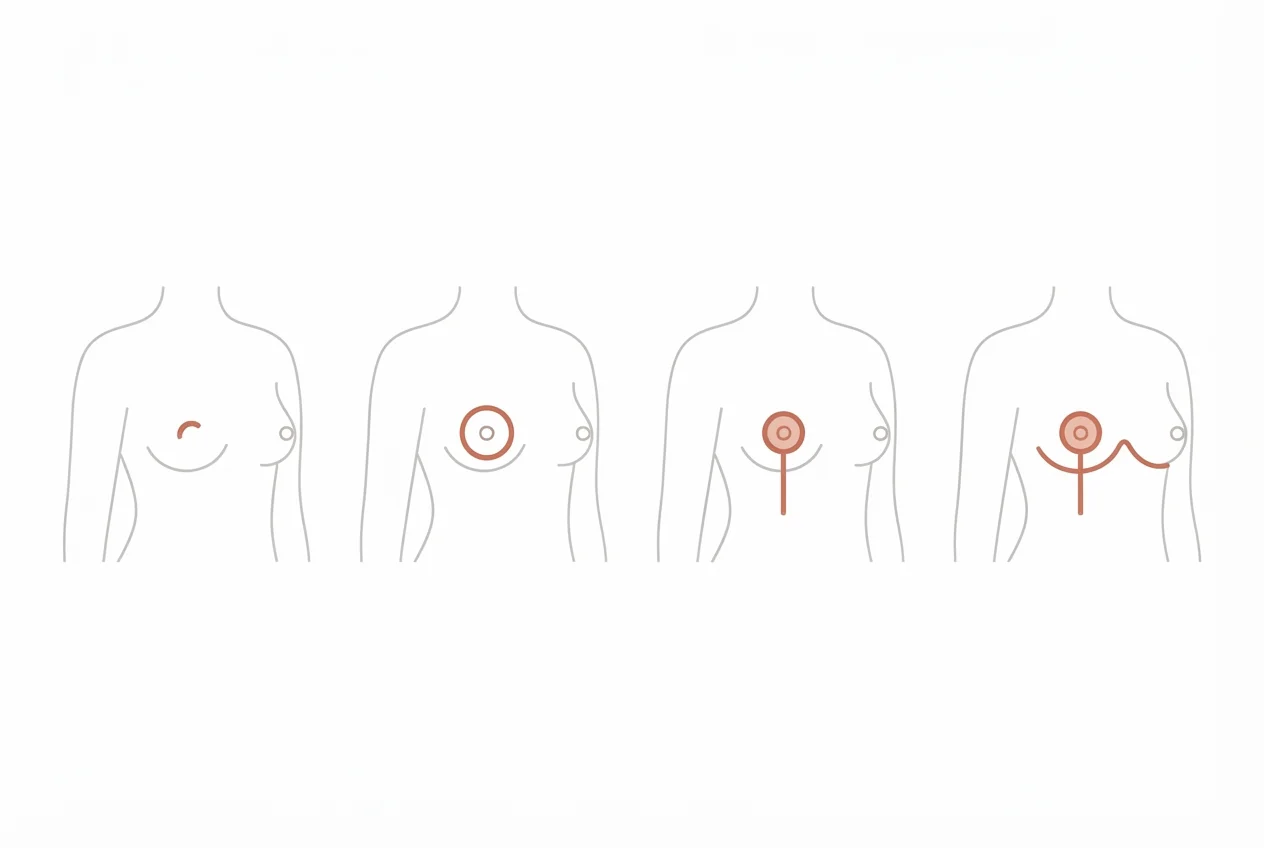
| Pattern | Where the scar sits | Sagging it typically suits | Trade-off |
|---|---|---|---|
| Crescent | A curved line along the upper edge of the areola | Minor sagging, sometimes alongside an implant | Uncommon. It removes a small piece of skin, so it lifts the least |
| Donut (periareolar, meaning around the areola) | A ring around the edge of the areola only | Mild to moderate | The least scarring of the full lift patterns, but limited to what can be corrected through a ring |
| Lollipop (vertical, also called keyhole) | Around the areola, plus a vertical line down to the breast crease | Moderate, without an implant | Moderate scarring. The vertical line sits on the breast itself |
| Anchor (inverted-T; surgeons call this design the Wise pattern) | Around the areola, down to the crease, and along the crease | Severe sagging, or combined with a breast reduction | The greatest lift and the most scarring. Where the vertical and crease lines meet (the T-junction), a wound can open, as one NHS hospital leaflet notes (S6) |
Scar length varies with your breast size, your skin and the surgical plan, so no pattern has a single length. Whichever pattern is used, the aim is that scars should not show in normal clothing, bras or bikini tops (S3). Ask your surgeon to show where each line will sit on your own breast.
You can also browse our breast lift before-and-after gallery for examples of results.
How is your pattern chosen, and when is the smaller scar the wrong choice?
Surgeons generally choose the pattern from the degree of sagging, the breast size and the correction wanted, and whether an implant or reduction is being combined (S2, S3). Scar length follows from those findings. It is not a target set in advance, and a smaller scar is not automatically the safer choice.
Our explanation of how each factor matters:
- Nipple position: How far the nipple must travel relative to the breast crease decides whether a ring around the areola can do the work.
- Loose skin: The more skin there is to remove, the more incision is needed to remove it evenly.
- Volume: Volume affects how much tissue must be reshaped as well as how much skin is removed.
- Combined procedures: An implant or a reduction can change the pattern. The anchor pattern, for example, is also used in breast reduction (S2). If size rather than position is your concern, our guide to breast reduction is the better place to start.
A pattern chosen only to keep the scar short may correct less than the sagging needs (S2). The plan is therefore tailored to the individual, not to a scar length.
At consultation we assess your medical history and candidacy, discuss options and risks, and give you a written surgical plan. You can read how the lift techniques compare first, then book a mastopexy consultation and we will go through your pattern with you.
How long do lift scars take to fade, and what is normal at each stage?
Most of the change happens in the first year: red or pink lines flatten and pale as the scar matures (S5), and fading can continue for up to two years or more (S4). We suggest judging the result from around one year, and allowing longer if the scar is still changing.
| Stage (approximate) | What normal looks like | When to call your surgeon |
|---|---|---|
| 0–6 weeks | Incision lines closed or closing, pink to red (S5) | |
| 6–12 weeks | Redness is part of active healing, and a scar can look more noticeable than it did at first (S5) | Redness or discharge is spreading, or a line is starting to widen |
| 3–6 months | Redness is still present (S5) | A scar is thickening or itching, growing beyond the incision line, or widening (S4) |
| 6–12 months | Maturation: collagen (the protein that forms scar tissue) flattens and the small blood vessels behind the redness recede (S5) | A raised scar is not flattening, a line is widening, or one breast looks persistently different from the other |
| 12–18+ months | Texture and colour can keep changing for up to two years or more (S4) | A scar is still raised, wide or clearly darker, or the asymmetry persists |
The table describes how the scar looks and when to call; for support, activity and everyday care in the early weeks, see our page on what to expect after breast lift surgery.
Why do some lift scars heal darker or thicker, and what changes on darker skin?
Scars darken or thicken when healing overshoots, with extra pigment or extra scar tissue. Darker skin carries a higher risk of both. It is a risk, not a certainty, and many people with darker skin heal well. The available numbers come from broad, mixed studies, so the research is limited.
Fitzpatrick skin types are a six-step scale of how skin reacts to sun. Types IV to VI cover light brown through to deep brown-black skin that tans readily and rarely burns. A 2024 review found people in these types are particularly predisposed to hypertrophic and keloid scarring, yet specific guidelines were lacking (Bronte et al., 2024).
The same review reports hypertrophic and keloid scarring in roughly 4.5 to 16% of Black and Hispanic populations, against about 0.09% in Fitzpatrick type I. These figures are not specific to breast lift scars or to Indian patients. A 2025 systematic review found darker skin types underrepresented in existing scar severity scales (Reid et al., 2025). Treat the figures as a sign of higher risk, not a prediction.
Three different things can happen:
- Darker pigment: The scar heals darker than the surrounding skin. Sun exposure can make this lasting (S5).
- Hypertrophic scar: Raised and firm, but it stays within the original wound and usually fades gradually (S4).
- Keloid: Raised, hard and smooth, and it grows bigger than the original wound. It needs treatment to improve (S4).
Other factors apply to every skin tone. Technique and a closure under less strain help, and smoking works against you (S2); one NHS hospital leaflet notes that it reduces the oxygen in your blood (S6). Infection or other wound-healing problems also affect the result (S2).
What we recommend if your skin is in types IV to VI, or you have scarred badly before: tell us about any keloid or thick scars, in you or your family, before surgery. Ask to see healed scars on skin like yours. Agree a review schedule with your surgeon; the 2014 guideline advises regular re-evaluation every four to eight weeks to judge whether further treatment is needed (S9).
How do you minimise scarring after a breast lift: what has evidence and what doesn't?
Sun protection, silicone as your surgeon advises, and not smoking all have supporting guidance.
-
Sun: One source advises avoiding direct sun on the scar for the first six months (S5); another advises keeping it covered for at least a year (S4). Use a broad-spectrum sunscreen as your surgeon advises. Where the sources differ, we would err towards the longer period, especially on darker skin.
-
Silicone: An expert panel of 24 recommends silicone sheets and gels as the first-line, non-invasive option for preventing and treating scars (Meaume et al., 2014). A 2020 meta-analysis of six randomised controlled trials (RCTs) with 375 patients found topical silicone gel lowered pigmentation, height and pliability scores after surgery (Wang et al., 2020). The evidence for prevention is mixed. A Cochrane review (an independent evidence review) rated it weak, because the trials were open to bias (O'Brien and Jones, Cochrane). A 2025 evidence summary gives only a weak recommendation for sheeting on existing hypertrophic scars, and notes it might work better at 16 hours a day or more (WHAM evidence summary, 2025). Most trials in that summary involved scars from burns or other trauma, not breast lift scars.
-
Massage: The NHS lists massage with a water-based cream as general scar self-care (S4); your surgeon will say when to start.
-
Start dates: Sources vary on when to begin silicone and massage, so timing follows your surgeon's instructions.
-
Daily habits: Not smoking, good nutrition and hydration all support healing (S2).

When should you call your surgeon about a raised or keloid scar, a wound opening or uneven breasts?
Call promptly for a wound that opens or shows signs of infection, and at the first sign of thickening, widening or persistent unevenness; the healing table above lists the triggers by stage. Most of these problems can be managed, and early review gives the most options.
- Wound opening: One NHS hospital leaflet notes that further wound care visits may be needed until it heals (S6).
- Raised scars: For a hypertrophic scar or keloid, your surgeon can discuss injectable treatments or revision surgery (S5).
- Widening or thickening: Some people have an inborn tendency for scars to stretch, and some scars stay thick, red and irritable for a long time (BAAPS patient leaflet). Your surgeon can discuss injections or scar revision (ASPS).
- Asymmetry: A difference between the breasts is a recognised complication (S3).
Can a poor scar be improved, and when?
Often, yes. For a raised or thick scar, surgeons may use steroid or 5-fluorouracil injections, and if injections do not flatten it, the scar can be cut out and re-closed (ASPS). ASPS surgeons advise not judging a scar until six months to a year have passed. A 2014 guideline advises re-evaluating at-risk scars every four to eight weeks to decide whether more treatment is needed (Meaume et al., 2014). Your surgeon decides the timing of any surgery.
What should you ask at a mastopexy consultation, and what should you bring?
Ask seven questions, each of which has a clear pass or fail answer. They work for any surgeon, including us.
- "Show me on my own breast where each incision will sit."Pass: the lines are marked or described against your areola and breast crease. Fail: "small scars" with no location.
- "Why this pattern, and not one smaller or larger?"Pass: the answer refers to your nipple position, skin and volume, and any combined implant or reduction. Fail: a generic answer.
- "What would a shorter-scar option leave uncorrected in my case?"Pass: a specific answer, such as nipple height or loose skin. Fail: "nothing".
- "Can I see healed scars at 12 months or more on skin like mine?"Pass: you are shown or told what healing looks like on similar skin, including the range. Fail: only early results, or "everyone heals well".
- "What happens if my scar thickens or darkens, and when will you review me?"Pass: a review schedule you agree. Fail: "come back if worried".
- "What is the plan if a wound opens?"Pass: you know who to contact and how. Fail: no route given.
- "Who follows me up after I go home?"Pass: a named follow-up route. Fail: "see your local doctor".
Bring your history of scarring (keloid, thick or slow-healing scars, in you or your family), your medicines, whether you smoke, any previous breast surgery, and photographs of existing scars elsewhere on your body. You can check who will operate on Dr Rajat Gupta's about page.
If you are travelling from outside Delhi/NCR or abroad, we begin with a video pre-consultation, so you arrive in Delhi with a clear surgical plan. After you return home, remote follow-up by video consultation continues.
What is the next step if you are worried about the scar?
Every effective breast lift leaves a scar, and the useful question is not whether you will have one but whether the pattern fits the correction you need. A shorter scar can leave a lift incomplete, a longer one buys more correction, and darker skin calls for an early review plan. Healing takes a year or more, so judge your result from around the one-year mark and call your surgeon sooner if a wound opens, redness spreads or a scar thickens.
At your consultation, ask to see where each incision will sit on your own breast, what a shorter option would leave uncorrected, and what healed scars look like on skin like yours. We tailor the plan to the individual and give you a written surgical plan after consultation. Patients travelling to us can start with a video pre-consultation.
Book a Consultation to go through your pattern with Dr Rajat Gupta.
Ask Dr Rajat Gupta where each incision will sit
Frequently asked questions
Sources
- 1.Global Survey 2025: International Survey on Aesthetic/Cosmetic Procedures performed in 2025, International Society of Aesthetic Plastic Surgery (ISAPS)
- 2.Breast Lift (Mastopexy) Scars & Incisions, The Aesthetic Society
- 3.Breast Uplift (Mastopexy), British Association of Aesthetic Plastic Surgeons (BAAPS)
- 4.Scars, NHS
- 5.What to expect as a scar heals following plastic surgery, American Society of Plastic Surgeons
- 6.Mastopexy or Breast Reduction, An NHS hospital trust patient information leaflet
- 7.Bronte J et al. A Comprehensive Review of Non-Surgical Treatments for Hypertrophic and Keloid Scars in Skin of Color. Clinical, Cosmetic and Investigational Dermatology, 2024;17:1459–1469.
- 8.Reid D et al. Keloids and hypertrophic scars in individuals with darker Fitzpatrick skin types: a systematic review of treatment efficacy and quality of life outcomes. Archives of Dermatological Research, 2025;317:795.
- 9.Meaume S et al. Management of scars: updated practical guidelines and use of silicones. European Journal of Dermatology, 2014;24:435–443.
- 10.Wang F et al. Efficacy of topical silicone gel in scar management: a systematic review and meta-analysis of randomised controlled trials. International Wound Journal, 2020;17:765–773.
- 11.O'Brien L, Jones DJ. Silicone gel sheeting for preventing and treating hypertrophic and keloid scars. Cochrane Database of Systematic Reviews, 2013.
- 12.Hulsdunk K, Haesler E. Silicone gel sheeting for healing hypertrophic scars: a WHAM evidence summary. Wound Practice and Research, 2025;33(4)., Cambridge Media