Under Eye Bags Surgery: Who It Helps and Who It Doesn't
Under eye bags surgery can move or remove fat and trim loose skin, but not fluid or skin colour. See causes, options, risks, recovery and what to bring.
Updated 27 Oct 2026

Key takeaways
- Under eye bags surgery suits bags caused by protruding fat, with or without loose skin. It is not the answer for fluid, allergy-related puffiness or darkness caused by pigment.
- Filler fills hollows and lasts from three months to about a year. It does not remove a protruding fat pad. Laser and peels act on the skin, not on fat.
- The main risks are dry eye, asymmetry, lid retraction, bleeding and, very rarely, sight-threatening bleeding behind the eye. Most people need about two weeks off work.
- A consultation decides the plan. Bring your dry-eye history, thyroid history, smoking status, medicines, any previous eyelid surgery and clear photos.
In this article
- 1What causes under-eye bags, and which causes can under eye bags surgery change?
- 2How can you tell bags from dark circles?
- 3What can surgery, filler, laser and home measures change for each cause?
- 4Can fillers, lasers or home measures replace under-eye surgery?
- 5What does lower blepharoplasty involve?
- 6Transconjunctival approach
- 7Skin pinch and subciliary approaches
- 8Fat grafting for the tear trough
- 9Who is lower eyelid surgery suited to, and when is it the wrong choice?
- 10What are the risks of lower eyelid surgery?
- 11What is recovery from eye bag surgery like, and when should you contact your surgeon?
- 12What happens at a lower eyelid surgery consultation, and what should you bring?
- 13Can outstation and overseas patients have the assessment remotely?
- 14Is lower eyelid surgery right for you?
- 15Frequently asked questions
Eyelid surgery was the most common surgical procedure worldwide in 2024, at more than 2.1 million procedures and up 13.4% on the year, according to the ISAPS Global Survey 2024. That figure covers upper and lower eyelid procedures together, so it cannot tell you whether surgery suits your bags.
Several different problems look like "bags" in the mirror: fat that has moved forward, skin that has loosened, a hollow beneath the bag that casts a shadow, and sometimes fluid. Surgery works on only some of them, so telling them apart is the decision that matters most.
Blepharoplasty is the medical term for eyelid surgery, and lower blepharoplasty is the version that treats the lower lid. Under eye bags surgery can be the right answer for a true fat bag and the wrong one for fluid or skin colour.
This page maps each cause to what surgery, filler, laser and home measures can and cannot change, then covers risks, recovery and how a consultation works, so you can decide with the facts in front of you.
What causes under-eye bags, and which causes can under eye bags surgery change?
Under-eye bags come from four things, often together: fat that has moved forward, loose skin, a hollow below the bag, and fluid. Lower blepharoplasty can change the first two, and sometimes the third. It does not treat fluid and does not change skin colour.
The tissues that support the lower lid weaken, so fat that normally cushions the eye moves forward and the skin sags. Fluid can also collect in the area and make it look swollen (Mayo Clinic). The three pockets of fat around the eye herniate (push forward) with age. Genetics matter, and tiredness, allergies and sinus congestion also contribute (American Society of Plastic Surgeons, ASPS). Herniated fat is a structural problem, so only a structural treatment moves it. Fluid and allergy are not structural, so no operation corrects them.
Bags are usually a cosmetic concern, but puffiness can also come from medical conditions such as thyroid eye disease, kidney disease or dermatitis. See your doctor if the puffiness causes vision problems, irritation or headaches, or comes with a skin rash (Mayo Clinic).
Hollowing that follows weight loss has a different cause from herniated fat. Our article on Ozempic face and Mounjaro face covers facial volume loss after weight loss.
How can you tell bags from dark circles?
Run these three checks in a mirror before a consultation. These checks are our own suggestions to help you describe the problem, not a clinical test. An examination makes the diagnosis.
- Light test.Look in even daylight, then lift your chin so a ceiling light shines from above. If the darkness deepens under a visible bulge and softens in flat light, it is shadow from a bag or hollow, and surgery may help. If the colour is the same in every light, it is pigment, and surgery will not change it.
- Timing test.
Photograph your eyes on waking and again at 6 pm for a week. Puffiness that is worse on waking and eases through the day points to fluid. Less salt and fewer fluids before bed can reduce it (Mayo Clinic). A bag that is the same size all day points to fat.
- Touch test.
A soft bulge on the lid is usually fat. A groove running from the inner corner of the eye down onto the cheek is a tear-trough hollow. If the bulge spreads onto the cheek, the cheek may be part of the problem. A lid operation alone does not lift a cheek, and that question belongs in a complete guide to facelift conversation. Our article on deep plane and SMAS facelift techniques covers cheek lifting.
What can surgery, filler, laser and home measures change for each cause?
| Cause | Lower blepharoplasty | Filler | Laser or peels | Home measures |
|---|---|---|---|---|
| Protruding fat pad | Yes: fat is removed or repositioned | Fills but does not remove the pad | May tighten skin to soften the look; does not remove fat | No effect |
| Loose skin | Yes, if skin is also removed | No | May tighten the skin | No effect |
| Tear-trough hollow | Fat repositioning or grafting may help | Fills the hollow, temporarily | No | No effect |
| Pigment-led dark circles | Not expected to change colour | Not the purpose of filler | Some lasers target pigment or visible vessels; suitability varies | Eye-area pigment-correcting products may help a little |
| Fluid, allergy or sinus-related puffiness | Not a surgical problem | Not suitable | Not suitable | Less salt and fewer fluids before bed |
Can fillers, lasers or home measures replace under-eye surgery?
Only when the problem is a hollow without a bulging fat pad, or fluid without a structural bag. Filler fills a hollow, lasers and peels work on skin, and home measures help fluid. None of them removes or moves a fat pad, which is what causes a true bag.
| Option | What it addresses | How long it lasts |
|---|---|---|
| Lower blepharoplasty | Protruding fat, loose skin, some hollows | Long-lasting, but ageing continues |
| Filler injected into hollows | Tear-trough hollow | Three months to one year (ASPS) |
| Laser resurfacing and peels | Skin quality | Treated in a single session or a series; acts on skin quality, not on fat (ASPS) |
| Less salt, fewer fluids before bed | Fluid-related puffiness (Mayo Clinic) | Only while the habit continues |
If a bag and a hollow sit together, the usual choice is between surgery that also repositions fat and a filler that softens only the shadow. Severe hollowing may need filler or fat grafting instead of fat removal (American Academy of Facial Plastic and Reconstructive Surgery, AAFPRS).
If you have brown or Black skin, ask your doctor which laser technique lowers the risk before you agree to resurfacing: Mayo Clinic notes it can cause permanent changes in skin colour.
What does lower blepharoplasty involve?
Lower blepharoplasty, the main eye bag removal surgery, removes or repositions the fat pads and, when needed, trims loose skin. The incision can sit inside the lid (transconjunctival), with or without a small skin pinch through a lash-line incision, or just below the lashes (subciliary). Which route is used depends on whether skin needs removing (AAO).
Transconjunctival approach
The incision sits on the inner surface of the lower lid, so there is no external scar. It suits fat without excess skin (AAFPRS).
Skin pinch and subciliary approaches
When there is excess skin, a small strip of skin can be removed through a fine incision just below the lash line, often added to the transconjunctival route (AAO; ASPS). In a subciliary approach, the incision is made just below the lash line from the start, allowing skin to be removed as well as fat to be removed or repositioned (AAFPRS).
Fat grafting for the tear trough
Fat can be repositioned or grafted to fill a concavity beneath the rim of the eye socket (AAO).
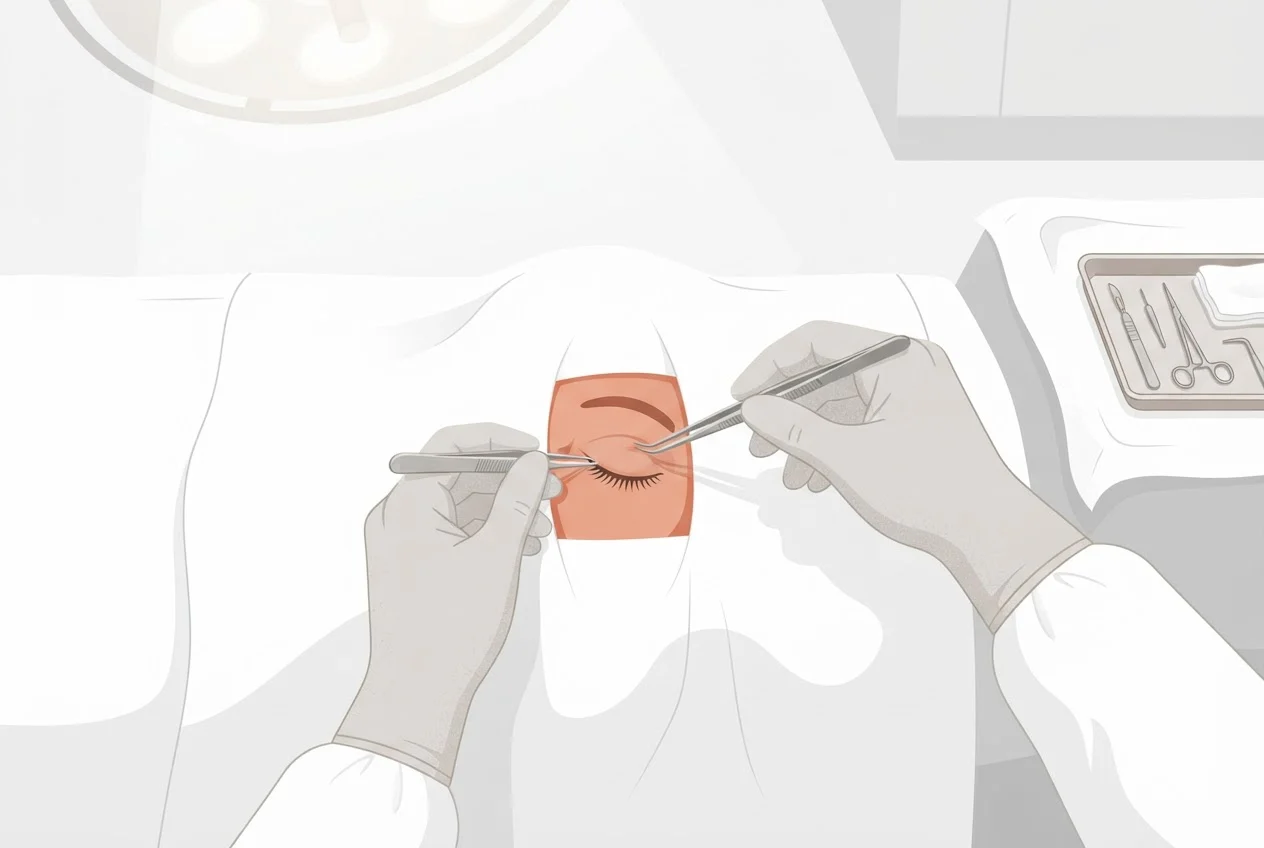
| Approach | Where the incision sits | Used when | External scar |
|---|---|---|---|
| Transconjunctival alone | Inside the lower lid | Fat bags, good skin elasticity | None |
| Transconjunctival plus skin pinch | Inside the lid, plus a fine line just below the lashes | Fat bags with some excess skin | Fine line along the lashes |
| Subciliary | Just below the lash line | Excess skin as well as fat | Fine line along the lashes |
| Fat grafting (added) | Not a separate incision | A hollow at the lid-cheek junction | Not applicable |
How the approach is chosen. Dr Rajat Gupta chooses between these routes by anatomy, not by habit. He uses the transconjunctival route when your anatomy allows it, adds a skin pinch through a lash-line incision when there is excess skin, and may add facial fat grafting to smooth the tear trough. The practice's lower eyelid surgery page sets out each approach.
Dr Gupta and colleagues also published a retrospective single-centre study of 88 patients treated through the transconjunctival route, in which 87 also had fat transfer to the lid–cheek junction (Cureus, 2024). It had no comparison group, so it cannot show that your result will match.
Lower eyelid surgery is sometimes planned alongside upper eyelid surgery or a facelift. That is a separate decision, covered in combining a facelift with eyelid surgery.
Who is lower eyelid surgery suited to, and when is it the wrong choice?
It suits adults with persistent bags from protruding fat, who are in good health, do not smoke or are willing to stop, and have realistic expectations (AAFPRS). It is the wrong choice in several situations.
- Active thyroid eye disease. The American Academy of Ophthalmology lists it as a relative contraindication (a reason to hold off) (AAO).
- Uncontrolled dry eye, unachievable goals and severe medical conditions. These are also listed as contraindications (AAO).
- Smoking. Candidates should be willing to stop smoking before and after surgery (AAFPRS).
- Darkness from pigment, or puffiness from fluid or allergy. Surgery moves fat and skin. It does not change colour or treat a trigger.
The NHS advises discussing surgery with your GP first, because a medical condition may make the operation inappropriate (NHS).
We start by asking whether surgery is indicated at all, and we discuss surgery, non-surgical options or both. Our page on who suits lower blepharoplasty covers candidacy in more detail.
What are the risks of lower eyelid surgery?
The main risks are dry eye, asymmetry, lid retraction, ectropion, bleeding and, very rarely, bleeding behind the eye that threatens sight. Two terms first. Lid retraction is the lower lid sitting too low, so a rim of white shows beneath the coloured part of the eye (scleral show). Ectropion is the lower lid rolling outwards, away from the eye.
| Risk | What it means | Source |
|---|---|---|
| Dry eye, difficulty closing the eyes | Listed as a risk. Dry eyes are part of early healing, and lubricating ointment may be applied. Tell your surgeon if dryness continues | |
| Asymmetry | The eyes look uneven | |
| Lid retraction | Can follow excessive skin removal or damage to the structure behind the lid; a mild, temporary pulling down of the lid can occur and often settles | |
| Ectropion | Rare, more serious malposition of the lid | |
| Bleeding | Bleeding from the incision lines, or into the eye socket | |
| Retrobulbar haemorrhage | Bleeding behind the eye; rare but an emergency, and a very rare cause of blindness |
Blurred or double vision can occasionally occur (NHS). ASPS also lists a possible need for revision surgery, and the NHS notes that some people need another operation if the result is not what they hoped for (ASPS; NHS). Your surgeon should discuss these risks, in relation to your own history, before you consent.
What is recovery from eye bag surgery like, and when should you contact your surgeon?
Most people need about two weeks off work and cannot drive for several days. Bruising and redness can take several weeks to fade (NHS). Early healing includes swelling, bruising, irritation and dry eyes, controlled with medication, cold compresses and ointment. Wear dark sunglasses and protect the area from the sun until healing is complete (ASPS).
In Dr Gupta's 88-patient study, swelling, bruising and chemosis (swelling of the clear membrane over the white of the eye) usually settled within one to two weeks. Fourteen patients had a foreign-body sensation that cleared in 48 to 72 hours. About one in five reported symptomatic dry eye in the first fortnight, and all cases had improved by 12 weeks with lubrication. Social activities resumed after about two weeks on average (Cureus, 2024).
Follow-up. Dr Gupta's team schedules review visits in the first weeks and again around three months, and remote review is available where an in-person visit is not practical.
Contact your surgeon or clinic at once for any of these, and go to an emergency department if you cannot reach them:
- Severe pain or any unexpected symptoms (NHS)
- Any sudden change in vision, including blurred or double vision
- Rapidly increasing swelling or pain around one eye
Bleeding behind the eye is rare but serious and needs urgent treatment (AAO). Your surgeon will tell you which symptoms matter most in your case.

What happens at a lower eyelid surgery consultation, and what should you bring?
The consultation takes 45 to 60 minutes. Dr Gupta examines your lid skin, fat distribution, tear-trough region and eye health, and his qualifications and registration are set out on his profile page. The consultation ends with a drawn incision plan, and a written plan covering technique, expected outcome, risks specific to your history, recovery and cost, with a written estimate. The cost depends on your anatomy and the technique chosen, so the figure comes from your personalised estimate. More on pricing is in how much blepharoplasty costs.
Bring the following. Each item tells us whether surgery is safe or sensible for you.
| Bring or note | Why it matters | Flag it if |
|---|---|---|
| Dry-eye history | Uncontrolled dry eye is a reason to hold off (AAO) | Your eyes sting or burn, or you need drops most days |
| Thyroid history | Active thyroid eye disease is a reason to hold off (AAO) | You have ever had a thyroid eye diagnosis |
| Smoking | Candidates are non-smokers or willing to stop (AAFPRS) | You smoke and would not stop |
| Medicines and supplements | Bleeding is a recognised risk (ASPS) | You take blood thinners or supplements |
| Previous eyelid surgery | Changes the anatomy and the plan | You have had any eyelid operation |
| Photos | Genetics play a part (ASPS); an old photo shows what has changed | Bring two clear daylight photos and one from years ago |
Book a consultation to be assessed in person or by video at RG Aesthetics, Shalimar Bagh, Delhi.
Can outstation and overseas patients have the assessment remotely?
Yes. Outstation and overseas patients can start with a video consultation before travelling, so you arrive in Delhi with a plan. For international patients, the team can provide a visa invitation letter and help with travel timing, accommodation (at the patient's cost) and airport transfers, and video follow-up continues after you return home. The international patient process explains the steps. For the video call, send the photos and history listed above.
Is lower eyelid surgery right for you?
It is right when examination shows protruding fat, with or without loose skin, in a healthy person with realistic expectations. For fluid, pigment, a dropped cheek or a hollow without a bag, another route is usually better, and sometimes a combination. That is why the first step is working out the cause, not choosing an operation.
Risks and recovery deserve the same honesty as results. Surgery moves fat and skin; it does not stop ageing, change skin colour or treat fluid, and you should leave any consultation knowing the risks that apply to you.
Dr Rajat Gupta's approach is to give honest answers, set realistic expectations and leave the decision with you, without pressure. If you are unsure which cause you have, book a consultation and he will tell you whether surgery, non-surgical options or both fit.
Find out if lower eyelid surgery suits you
Frequently asked questions
Sources
- 1.Mayo Clinic: Bags under eyes, symptoms and causes
- 2.Mayo Clinic: Bags under eyes, diagnosis and treatment
- 3.American Academy of Ophthalmology (EyeWiki): Lower eyelid blepharoplasty
- 4.American Society of Plastic Surgeons: Eyelid surgery safety
- 5.American Society of Plastic Surgeons: Eyelid surgery recovery
- 6.American Society of Plastic Surgeons: How to get rid of undereye bags
- 7.American Academy of Facial Plastic and Reconstructive Surgery: Lower eyelid surgery
- 8.NHS: Eyelid surgery
- 9.International Society of Aesthetic Plastic Surgery: Global Survey 2024
- 10.Gupta R, Khosa A, Bansal P, Chaudhury G. Exploring the Versatility of Transconjunctival Blepharoplasty: A Retrospective Single-Center Study. Cureus, 2024 (DOI 10.7759/cureus.72929)