
Thread Lift vs Facelift: How Long Each Lasts and Where Threads Stop
Thread lift vs facelift depends on how much sag you have. Threads give a modest lift that sources put at roughly six months to three years. A facelift repositions deeper tissue, with the practice's ranges of about five to twelve years by technique. These are ranges that vary by person, not promises.
Updated 5 Nov 2026
Key takeaways
Who each suits: A thread lift suits early, mild laxity and gives a modest, temporary lift. A facelift is the more direct option once jowls, a blurred jawline or loose neck skin are established, because threads cannot remove skin or reposition deeper tissue.
How long each lasts: Sources put a thread lift at roughly six months to three years, and our planning ranges for a facelift are about 5 to 12 years by technique. These are ranges that depend on the person, and thread evidence is limited and short-term, so no figure is a promise.
Risks: Threads can cause dimpling, lumpiness, visible or extruding threads and infection. Surgery adds anaesthetic, bleeding and facial nerve risks, which is the trade for a deeper lift. Neither is risk-free.
Cost over time: Threads cost less per session (₹49,738 for a pair at our published price) but fade and can be repeated. A facelift is a larger single cost (published ranges of ₹2,00,000 to ₹5,00,000), so compare the total plan over five and ten years, not the first price.
In this article
- 1Thread lift vs facelift: how do they differ at a glance?
- 2What does a thread lift do, and why does the effect fade?
- 3What does a facelift do differently from threads?
- 4How long does a thread lift last, and why do published figures vary?
- 5Where do threads stop working for jowls, jawline and neck?
- 6What are the thread lift side effects, and how do they compare with facelift risks?
- 7Which complications follow thread lifts?
- 8What surgical and anaesthetic risks come with a facelift?
- 9Who does a thread lift suit, and who is better served by a facelift?
- 10Is non-surgical care enough for early laxity?
- 11Who is a thread lift less likely to suit?
- 12Thread lift vs mini facelift: is a mini facelift the middle route?
- 13Can you have a facelift after a thread lift?
- 14What do a thread lift and a facelift cost over time?
- 15What should you ask at a thread lift or facelift consultation?
- 16What is the next step if you are weighing threads against surgery?
- 17Frequently asked questions
A facelift vs thread lift decision is often framed as a small and a large version of the same idea. In practice they answer different questions: one buys time, the other changes where tissue sits. Mixing them up can lead to disappointment with threads, or to surgery earlier than you needed.
The people asking are usually in their late 30s to 50s, with jowls or cheek sag that has only recently started, and want to know whether threads will be enough. The honest answers are less tidy than a headline figure suggests. Evidence on threads is small and short-term, and every duration on this page, ours included, is a range.
We offer both facelift surgery and absorbable thread lifts, so weigh what follows with that in mind. For early ageing, our position is that non-surgical care may be preferable to surgery. Below we say where we think it stops being enough, and how the costs compare over time.
Thread lift vs facelift: how do they differ at a glance?
A thread lift gives a modest, temporary lift that lasts roughly six months to three years. A facelift repositions deeper tissue and, on our planning ranges, lasts roughly five to twelve years depending on technique. Both are ranges that vary by person, and neither is a guarantee.
| Feature | Thread lift | Facelift |
|---|---|---|
| Layer treated | Soft tissue under the skin, supported by absorbable threads | Deeper tissue layers, such as the SMAS (superficial musculoaponeurotic system), repositioned |
| Anaesthesia | Usually local anaesthetic, confirmed at assessment | Most facelifts are done under general anaesthesia |
| Recovery | About 2 to 3 weeks to return to work and social activity (our estimate) | |
| Typical duration | 6 to 12 months up to 1 to 3 years, depending on source and person | About 5 to 12 years by technique (our planning ranges) |
| Can change | Mild cheek or jowl softness, early laxity | Established jowls, jawline definition, loose neck skin |
| Cannot change | Excess skin, deep descent of tissue, volume loss | Volume loss, and the ageing that continues afterwards |
What does a thread lift do, and why does the effect fade?
A thread lift places absorbable threads under the skin to hold sagging tissue higher. The American Society of Plastic Surgeons (ASPS) describes it as minimally invasive, using absorbable barbed sutures that can mechanically lift tissue and stimulate collagen, for people who want to reduce wrinkles, early jowls and sagging skin.
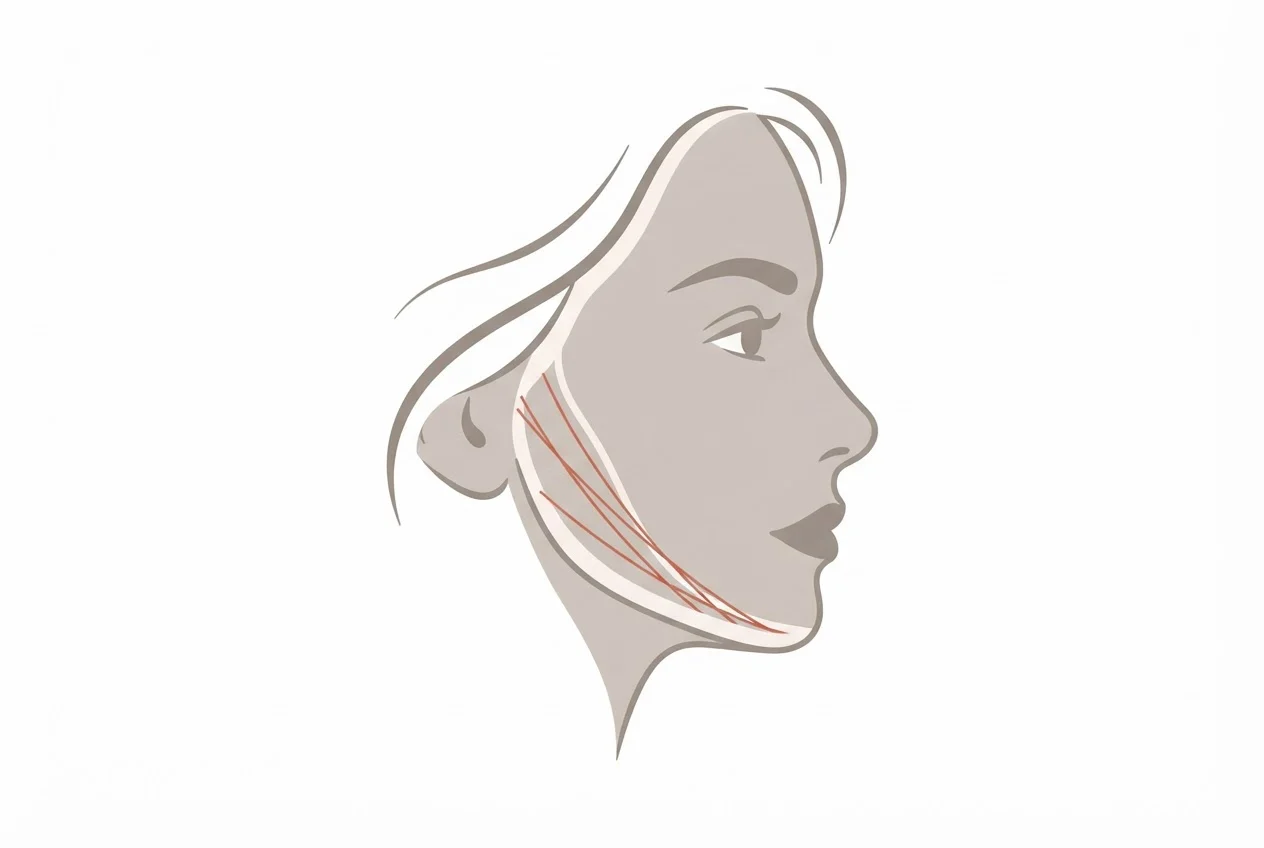
We say "thread lift" rather than "non-surgical facelift" because threads support tissue. They do not reposition the deeper layer or remove skin, which is what a facelift does.
The effect fades because the lift is largely mechanical and the threads are absorbed. Some of the early look is swelling. A 2009 retrospective review of 33 patients who had thread lifts, alone or with other procedures, followed for about 21 months, concluded that the lift gave only limited short-term improvement, which the authors attributed largely to swelling and inflammation. Threads and techniques have changed since, so treat that as a caution, not a verdict.
Threads may also stimulate collagen. That is plausible but not proven in controlled studies. The Association of Cutaneous Surgeons of India's 2026 consensus statement describes the evidence for a durable lift as limited.
What does a facelift do differently from threads?
A facelift lifts and repositions the deeper facial tissues instead of only tightening skin. It improves sagging cheeks, jowls, jawline definition and loose neck skin. We may recommend a mini facelift, a SMAS facelift or a deep plane facelift, depending on your anatomy, ageing pattern and goals.
A SMAS facelift works on the SMAS layer under the skin. A deep plane facelift releases and repositions the deeper retaining ligaments of the face, and how the SMAS and deep plane techniques differ has the comparison. The price of the stronger lift is an operation and incisions. Our facelift page explains the techniques, recovery and what to expect if you go that way.
How long does a thread lift last, and why do published figures vary?
The lifting effect of a thread lift is described as lasting roughly six months to three years. The Association of Cutaneous Surgeons of India's consensus statement says effects do not persist beyond 6 to 12 months. Cleveland Clinic (updated January 2023) gives one to three years.
The gap is real. Long-term evidence is limited, and your result depends on how much laxity you started with, your skin quality, and how many threads were placed and where. Treat any single number as an estimate.
Our planning ranges for surgery, by technique, are about 5 to 7 years for a mini facelift, 7 to 10 for a SMAS facelift and 8 to 12 for a deep plane facelift. They are the practice's planning ranges, not promises. Faces keep ageing after either option, and our guide to surgical facelift longevity covers the surgical detail.
Where do threads stop working for jowls, jawline and neck?
Threads stop being enough when the sag is established: heavier jowls, a blurred jawline, loose neck skin or bands, or skin that has thinned. A thread supports tissue but cannot remove skin or reposition the deeper layer.
In our practice, we put it this way: thread lifts can give a modest temporary lift for selected patients, but they cannot reposition deeper facial structures.
Which problem, which option, as a starting point for your consultation:
- Early cheek softening or mild jowls: threads or other non-surgical care are reasonable to discuss.
- Established jowls or a blurred jawline: a mini facelift or fuller facelift usually gives more.
- Loose neck skin or bands: this needs work on the neck itself, so see neck lift surgery.
- Hollow cheeks: this is volume loss, which facial fat grafting addresses rather than a lift.
What are the thread lift side effects, and how do they compare with facelift risks?
Both options carry risks. Thread lift side effects are usually milder and more often temporary, while a facelift has a longer and more serious risk list, which is the trade for a deeper lift. Neither is risk-free.
Which complications follow thread lifts?
The recognised effects are dimpling or puckering, lumpiness or a pulling sensation, swelling, bruising, asymmetry, visible threads and infection.
- ASPS lists extrusion (a thread working its way out), infection, persistent pain, swelling and bruising, sensitivity to light, and an unfavourable result.
- Cleveland Clinic adds allergic reactions, bleeding and lumpiness.
- The Indian consensus statement lists swelling, dimpling and minor infections, and describes serious events as rare.
A systematic review of 59 articles covering 14,222 patients, almost all of them treated with barbed threads, found asymmetry, swelling and bruising the most common effects. Most effects were transient and settled by themselves, with the exception of contour irregularities, injuries to vessels or glands, infections and inflammatory reactions. Serious effects, such as altered sensation, hair loss and injury to vessels or glands, were rare, and the more serious cases subsided with treatment.
A separate meta-analysis of facial thread lifting put the pooled incidence of swelling at 35%, skin dimpling at 10%, altered sensation at 6%, visible or palpable threads at 4%, infection at 2% and thread extrusion at 2%. These figures pool studies of different threads and techniques, so treat them as a guide to how common each problem is, not a prediction for you.
Our advice: early lumps or dimples often settle. Redness, heat, discharge, a visible thread or worsening pain should be seen by the clinician who placed the threads, not waited out.
What surgical and anaesthetic risks come with a facelift?
ASPS lists anaesthesia risks, bleeding, deep vein thrombosis (clots in the leg veins) and cardiac or lung complications, and facial nerve injury with weakness. It also lists fluid accumulation, infection, numbness, persistent pain, poor wound healing and skin loss, hair loss at the incisions, unfavourable scarring and asymmetry.
We reduce these by assessing your medical history and candidacy at consultation, discussing the risks with you, and planning pre-anaesthetic assessment and theatre care before any operation.
Who does a thread lift suit, and who is better served by a facelift?
A thread lift suits people with early, mild sagging who want a subtle change without an operation. A facelift suits people whose jowls, jawline or neck have changed enough that support alone will not hold. Skin quality, facial structure and expectations decide the rest.
Is non-surgical care enough for early laxity?
For early laxity, a non-surgical route is often the more proportionate first step, and that is our starting position. ASPS describes thread lifts for people wanting to reduce wrinkles and early jowls. Cleveland Clinic places good candidates in their late 30s to early 50s, with early signs of ageing and a wish for subtle change. Expect subtle, temporary results, repeated if you want to keep them.
Who is a thread lift less likely to suit?
A thread lift is less likely to suit you if you want a dramatic change or have a lot of loose, sagging skin. Cleveland Clinic describes threads as generally best for people with early signs of ageing who do not expect dramatic results, and the heavier jowls, blurred jawline and loose neck skin described above are where threads fall short.
The picture changes for people who cannot have an operation. Cleveland Clinic notes that, because thread lifts are low-risk, they can be an option for some people with conditions such as high blood pressure, diabetes or heart disease who cannot have a traditional facelift. Whether that applies to you is a decision for your examining doctor.
Tell your clinician before any thread lift if you have a skin infection in the treatment area, a history of reacting to stitches, or take medicines that affect bleeding, so these can be assessed first.
Thread lift vs mini facelift: is a mini facelift the middle route?
A mini facelift is the middle route when threads are unlikely to be enough but a full facelift is more than you need. It addresses early facial ageing through shorter incisions and more limited tissue repositioning. Our mini facelift page describes incisions along the hairline and around the ears. If your sag is deeper, a SMAS or deep plane technique may be recommended instead.
Can you have a facelift after a thread lift?
Usually yes, once your surgeon has examined you and knows what was placed. Tell them how many threads you had, when, where and of what type, and bring any records. Whether earlier threads change the surgical plan is a decision for your examination, not something to assume.
What do a thread lift and a facelift cost over time?
As of 10 October 2026, our published price is ₹49,738 for a pair of Silhouette Soft threads. Our published facelift ranges are ₹2,75,000 to ₹4,50,000 for a mini facelift, ₹3,28,769 to ₹4,55,187 for a classical facelift and ₹2,00,000 to ₹5,00,000 for an endoscopic facelift.
The total for threads depends on how many pairs your face needs and how often they are repeated, which is decided at examination. Because the effect fades, threads can be repeated if you want to keep the result, so the cost of several sessions can add up over the years. Surgery is a larger single cost, though its results also change as the face keeps ageing. When you compare, ask for the total cost of the plan over five and ten years, not just the first session.
Prices are per case, and a personalised written estimate follows consultation. Ask what it includes. For surgery, care can include pre-anaesthetic assessment, theatre care, a hospital or day-care stay, garments and follow-up.
What should you ask at a thread lift or facelift consultation?
Ask questions you can score as a pass or a fail. These seven separate a considered recommendation from a sales pitch:
- Registration Search the National Medical Commission (NMC) Indian Medical Register by name, registration number or state medical council. Pass: the entry matches the name and council you were given. Fail: no matching entry. We are happy to share our registration details on request.
- Examination Pass: your face is examined at rest and in movement, and you are told whether skin, volume or deeper sag is the main problem. Fail: a recommendation before any examination.
- Duration Pass: a range with reasons. Fail: a fixed number or a guarantee.
- Complications Ask what happens if you get dimpling, a lump, a visible thread or an infection, and who treats it. Pass: a named plan. Fail: vagueness.
- Both options Pass: you hear when threads would not be enough. Fail: only one option presented.
- Written estimate Pass: per-case and itemised, stating what is included. Fail: a figure given only verbally.
- Previous threads Pass: the surgeon asks for records of any threads you have had.
What is the next step if you are weighing threads against surgery?
Start with an examination. It tells you whether your sag is early enough for threads, or established enough that a mini facelift or fuller facelift would give you more.
We can also see outstation and international patients by video consultation. To book, use our contact page (phone and WhatsApp: +91-9560156136).
This page is general information, not a diagnosis. An examination decides what suits you.
Book an examination with Dr Rajat Gupta
Frequently asked questions
Sources
- 1.Thread lift (ASPS)
- 2.Thread lift safety (ASPS)
- 3.Thread lift results (ASPS)
- 4.Facelift safety (ASPS)
- 5.Thread lift, Cleveland Clinic, updated 7 January 2023
- 6.Pham et al., Safety Profile of Thread Lifts on the Face and Neck: An Evidence-Based Systematic Review, Dermatologic Surgery, 2021
- 7.Abraham et al., Thread-lift for facial rejuvenation: assessment of long-term results, Archives of Facial Plastic Surgery, 2009
- 8.Consensus position statement on emerging treatments in dermatology, Association of Cutaneous Surgeons of India Task Force, Journal of Cutaneous and Aesthetic Surgery, 2026
- 9.NMC Indian Medical Register
- 10.Our treatment and procedure pricing, as of 10 October 2026
- 11.Niu et al., A Meta-Analysis and Systematic Review of the Incidences of Complications Following Facial Thread-Lifting, Aesthetic Plastic Surgery, 2021