
Breast Augmentation Guide: What to Decide and Ask Your Surgeon
To choose breast implant type, size and placement, treat them as linked decisions made together from your measurements, tissue cover and goals. Ask your surgeon to explain each choice and the risks, and get the estimate in writing.
Updated 30 Oct 2026

Key takeaways
The decisions are linked. Implant type, surface, size, placement and incision depend on each other. Chest width, breast tissue and your goals decide them together, so a sound plan explains all five at once.
Size comes from measurements, not cup size. Surgeons plan volume in cubic centimetres (cc) against chest width and tissue cover. Cup sizes vary between brands and countries, so a cup-size target is a poor brief.
Raise the risks and trade-offs. Ask about rupture, capsular contracture (hardening of the tissue around the implant), revision surgery and imaging follow-up. The US Food and Drug Administration (FDA) says implants are not lifetime devices and advises you to assume further surgery may be needed.
Check registration and get the estimate in writing. Look the surgeon up on the National Medical Commission (NMC) Indian Medical Register, and ask for an itemised written estimate after consultation, not a price from a photo or message.
In this article
- 1Is breast augmentation with an implant the right route for the change you want?
- 2How do implant type, surface, size, placement and incision depend on each other?
- 3Silicone gel or saline: how do they feel, and how does follow-up differ?
- 4Smooth or textured surface: how does a rare lymphoma risk affect the choice?
- 5Implant size: why is volume in cc, not cup size, the number that matters?
- 6Placement: over, under or dual plane?
- 7Incision: under the breast, around the areola or through the armpit?
- 8Table A: the five decisions side by side
- 9What should a breast augmentation consultation settle?
- 10What does the operation and recovery involve?
- 11What risks should you discuss before booking breast augmentation?
- 12The FDA patient decision checklist
- 13What questions should you ask a breast augmentation surgeon?
- 14Table B: questions and what a good answer looks like
- 15How do you check a surgeon's registration on the NMC register?
- 16What should a written estimate for breast augmentation list?
- 17Table C: what a written estimate should itemise
- 18How does breast augmentation work for outstation and overseas patients?
- 19Conclusion
- 20Frequently asked questions
Breast augmentation is among the most requested cosmetic operations worldwide. The ISAPS Global Survey 2024, from the International Society of Aesthetic Plastic Surgery (ISAPS), ranks it third among surgical procedures, after eyelid surgery and liposuction. It also reports that 54% of augmentations were performed on 18- to 34-year-olds.
Most readers start with narrow questions: silicone or saline, how many cc, over or under the muscle. Each is fair, and none can be answered alone. A volume that suits a broad chest with firm tissue can look heavy, or show its edges, on a narrow chest with thin cover.
This guide takes the decisions in the order they constrain one another. It includes three tables you can use: the five decisions side by side, questions to put to any surgeon, and what a written estimate should list. It cannot replace a consultation, because the right answer depends on measurements that only an examination provides.
Is breast augmentation with an implant the right route for the change you want?
An implant adds volume and projection; it does not lift a breast. If your main concern is that your breasts have lost firmness or sit low, a lift may suit you better, and some women need both. Fat transfer, and hybrid approaches that combine fat with an implant, use your own tissue instead of, or alongside, a device.
The American Society of Plastic Surgeons (ASPS) describes breast augmentation as using implants or fat transfer to increase breast size. In practice the routes differ like this:
- Implant: adds a clear, predictable increase in volume. The rest of this guide covers it.
- Fat transfer: moves fat from another part of your body into the breasts. Our recommendation is to expect a smaller increase than with an implant, and to have enough fat available to harvest. Our page on the alternatives to breast implants sets out fat transfer, lift and reconstruction options.
- Hybrid: an implant with fat grafting around it, used when your surgeon judges that contour needs both.
- Lift: reshapes and repositions the breast by removing excess skin. It adds no volume.
- Less volume: if you want smaller breasts, our breast reduction guide is the better starting point.
When to wait: if you plan a pregnancy soon, tell your surgeon at the first consultation. Our recommendation is to consider waiting until your family is complete, or at least until breastfeeding has finished and your breasts have settled. Pregnancy changes breast size and shape, which can alter an earlier result, and the NHS notes that implants may reduce the amount of milk you produce slightly. If you are already concerned about sagging after breastfeeding, read that page first.
You can read how we approach the operation on our breast augmentation service page. Nothing in this guide replaces an examination.
How do implant type, surface, size, placement and incision depend on each other?
Each choice narrows the next. Your tissue cover and chest width limit how much volume looks natural. Volume and cover influence whether the implant sits over, under or partly under the muscle. Placement and anatomy influence which incision is workable. ASPS says the way implants are inserted and positioned depends on the implant type, the enlargement you want, your body type and your surgeon's recommendation.
Silicone gel or saline: how do they feel, and how does follow-up differ?
Silicone and saline implants both have a silicone shell. Saline implants are filled with salt water, silicone implants with gel (FDA). The NHS says silicone implants feel more natural and are less likely to wrinkle than saline.
Follow-up is the part people overlook. The FDA states that a rupture of a silicone implant, called a silent rupture, usually does not change how the breast looks or feels. It names MRI (magnetic resonance imaging) as the most effective way to detect it, with ultrasound as an acceptable alternative, and recommends a screening scan five to six years after silicone implant placement and every two to three years after that. A ruptured saline implant loses volume, so it is usually noticed.
Smooth or textured surface: how does a rare lymphoma risk affect the choice?
Breast implant-associated anaplastic large cell lymphoma (BIA-ALCL) is a cancer of immune cells that can develop in the scar tissue around an implant, and the surface of the implant affects the risk. Implant shells differ in surface texture and shape (FDA). Smooth implants can move slightly in their pocket; textured implants grip the surrounding tissue, as ASPS explains.
The FDA reports that BIA-ALCL develops more frequently with textured implants than with smooth ones. ASPS describes it, and squamous cell carcinoma in the capsule, as very rare.
If your surgeon proposes a textured implant, ask what in your anatomy justifies it. Whatever surface you choose, report new swelling, pain or a lump around an implant.
Implant size: why is volume in cc, not cup size, the number that matters?
A cc, or cubic centimetre, is a unit of volume. It is what implants are measured in. Cup sizes are not a reliable guide because they vary between brands and countries, so surgeons plan from cc, base width (the width of the breast on the chest), tissue thickness and projection (how far the implant stands forward). We explain this in our guide to choosing the correct cc for your implant.
The same volume looks different on different chests. It reads larger on a narrow chest, and thinner tissue cover shows more of the implant. Placement changes the picture too, because muscle cover softens the outline. Chest-wall shape and any asymmetry matter as well. Proportion is the real goal, which is why our page on the importance of size and proportion is worth reading before you form a number in your head.
Placement: over, under or dual plane?
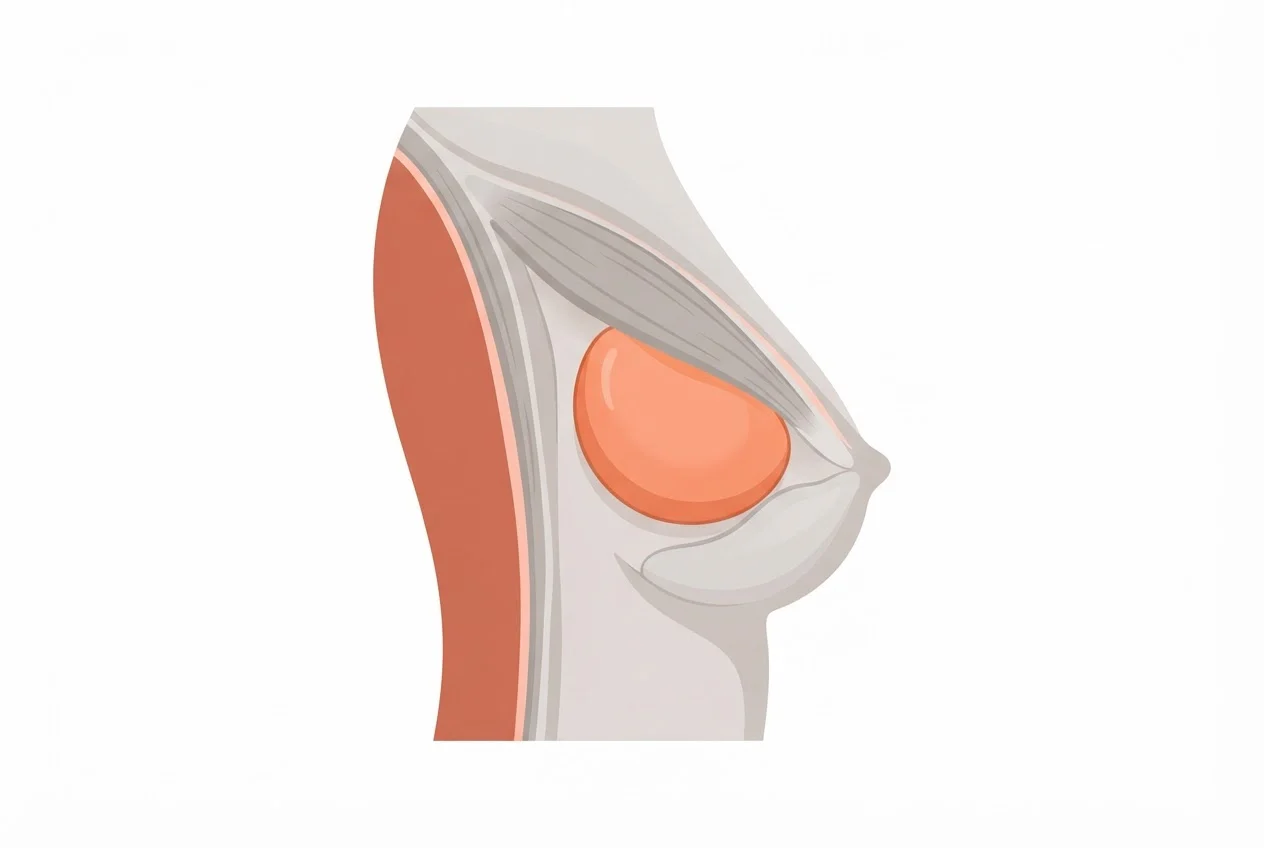
ASPS describes two positions: under the pectoral muscle, or directly behind the breast tissue and over the muscle. The surgical literature describes a third, dual plane, which places part of the implant under the muscle and part under the breast tissue, adjusting the relationship between implant and soft tissue across a range of breast types.
| Placement | Where the implant sits | Trade-off to discuss |
|---|---|---|
| Over the muscle (subglandular) | Behind breast tissue, in front of the chest muscle | Needs enough tissue cover; thin cover can let the implant edge or rippling show |
| Under the muscle (submuscular) | Behind the chest muscle | More cover over the implant; the muscle can move it when you tighten your chest |
| Dual plane | Partly under muscle, partly under breast tissue | Balances cover and shape; suits many breast types |
Our view: thinner tissue cover generally points towards more muscle cover, and firmer, fuller tissue gives more choice. Only an examination can say which applies to you. Mammograms remain safe with implants; the NHS advises telling the radiographer you have them.
Incision: under the breast, around the areola or through the armpit?
ASPS lists four incision sites: under the breast (inframammary), around the areola (periareolar), the armpit (axillary) and the belly button (transumbilical), and states that the belly-button approach has a higher complication rate. The choice depends on implant type, the enlargement you want, your anatomy and your preference.
Table A: the five decisions side by side
| Decision | What it changes | What it depends on | What to ask |
|---|---|---|---|
| Fill: silicone gel or saline | Feel, and how rupture is detected | Tissue thickness, your preference, willingness to attend imaging | "How will a rupture be found, and when do I need scans?" |
| Surface: smooth or textured | Implant movement and BIA-ALCL risk profile | Anatomy, surgeon's reasoning | "Why this surface for my chest?" |
| Size: volume in cc | How large and proportionate the result looks | Base width, tissue cover, chest shape, goals | "What range suits my measurements?" |
| Placement: over, under, dual plane | Cover, outline, how the implant moves | Tissue thickness, implant type and size | "What cover will I have over the upper edge?" |
| Incision: under breast, areola, armpit | Where the scar sits and how the pocket is made | Implant type, size, anatomy, preference | "How would a revision be done?" |
What should a breast augmentation consultation settle?
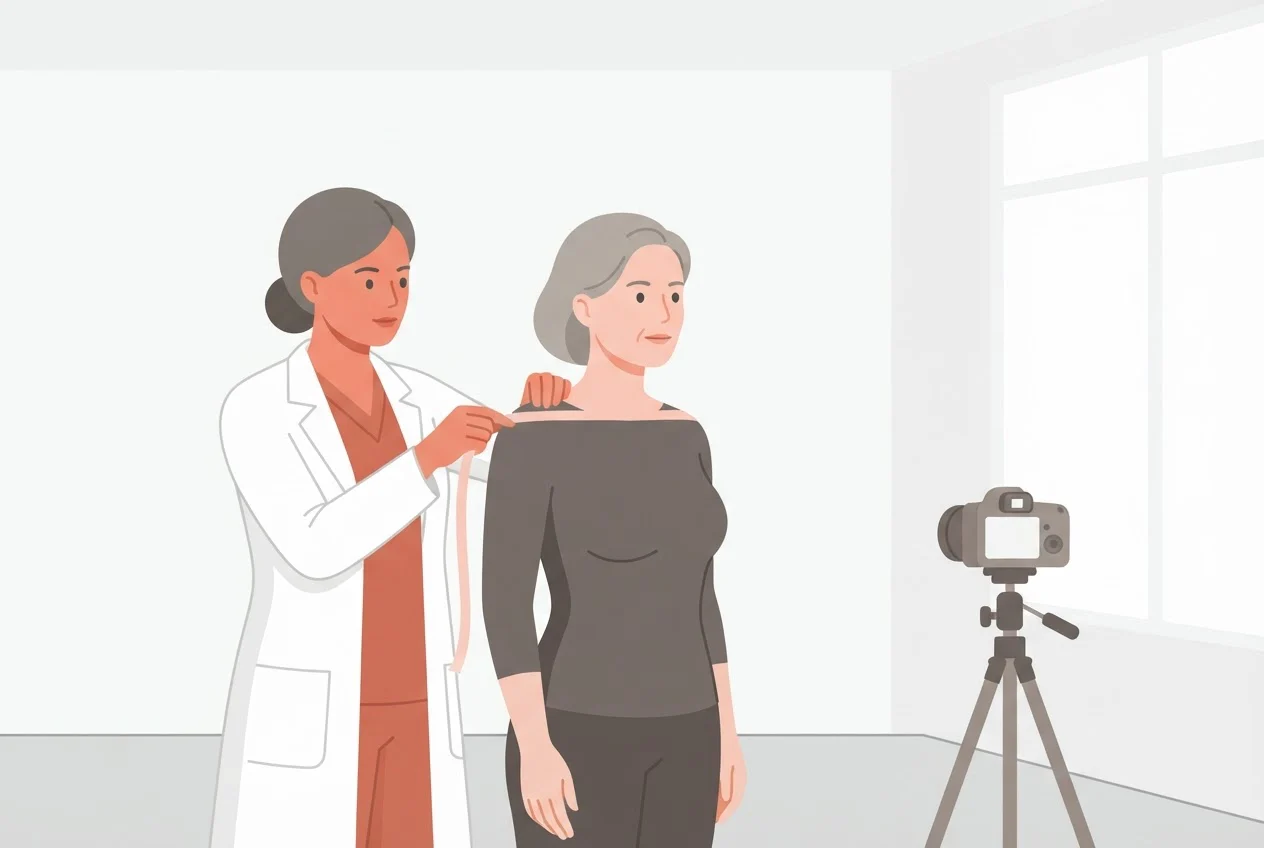
A consultation should end with a recommended combination of the five decisions, explained against your own measurements, a realistic picture of the result, and a written plan. ASPS describes the consultation examination as measuring breast size and shape, skin quality and nipple and areola position, with photographs taken.
A thorough visit covers:
- History: medical conditions, medications, allergies, previous breast biopsies, and family history of breast cancer.
- Examination and measurements: these are the inputs for the size and placement decisions above.
- Options and risks: implant, fat transfer, hybrid or lift, with the downsides of each.
- A preview of volume: surgeon's sizers (trial implants placed in a bra) show volume, not the exact shape. Where 3D simulation is offered, treat it as an approximation of appearance and ask what it cannot show.
- A realistic result: natural-looking and in proportion with your frame. No honest surgeon promises a particular size or a result identical to a simulation.
What does the operation and recovery involve?
At our practice, implant surgery takes about an hour, and fat transfer or a hybrid approach adds 30 to 60 minutes. It is done under general anaesthesia, usually as day care, with an occasional overnight stay. The NHS suggests a week or two off work, with normal activities resuming after about six weeks. Implants take several months to settle into their final position, so judge the result later rather than early. Your surgeon will set a plan for your own recovery, and our recovery guide covers it in detail.
What risks should you discuss before booking breast augmentation?
The FDA lists the main complications of implants as reoperation, capsular contracture, rupture or deflation, BIA-ALCL, squamous cell carcinoma in the scar capsule, and effects on breastfeeding (FDA). ASPS also states that the vast majority of people with implants experience no serious complications. Both statements are true together, and you should hear both.
Raise these in turn:
- Capsular contracture: the FDA defines it as hardening of the breast around the implant. Ask how it is recognised and treated; the causes are not fully understood.
- Rupture and imaging: a silicone rupture can be silent. Ask who arranges the scans described earlier, and what they involve.
- Revision: the FDA advises assuming that you will need more surgery at some point, because implants are not lifetime devices. How long an implant lasts varies, so ask how revision would be planned.
- BIA-ALCL and related cancers: very rare, with a link to textured surfaces as covered above.
- Breastfeeding and sensation: the NHS notes possible effects on milk supply and on nipple sensation.
- Cosmetic risks: rippling, an implant that moves out of position, and scars that heal less neatly than hoped.
The FDA patient decision checklist
The FDA requires that a patient decision checklist be reviewed with you, so that you understand the risks and benefits, and you must be given the chance to initial and sign it before agreeing to surgery. The ASPS 2026 checklist covers rupture, BIA-ALCL, monitoring, the limited lifespan of implants, and complications such as infection and capsular contracture. That requirement applies to devices in the US market, but our recommendation is to ask any surgeon to walk you through the same list, whatever country you are in.
What questions should you ask a breast augmentation surgeon?
Ask the questions in Table B, and judge the answers against the pass and fail columns. A good answer refers to your own measurements and names a trade-off. A poor answer is a single favourite option, a number given without measurements, or any claim of no risk. Take the table to every consultation, including a second opinion.
Table B: questions and what a good answer looks like
| Question | Pass | Fail |
|---|---|---|
| Why this fill, surface, size, placement and incision for my chest? | Refers to your measurements and tissue, and explains how the five link | One favourite option for everyone, or "most patients choose this" |
| What can sizers or 3D simulation show? | Says they show volume or approximate appearance, not a guarantee | Promises the exact result |
| Which risks apply to me? | Covers rupture, capsular contracture, revision and, if textured, BIA-ALCL | Says there is no risk, or that implants last for life |
| What imaging and follow-up will I need, and when? | Names the scan type and schedule for your implant type | No plan for monitoring |
| What happens if I need a revision? | Explains the process and what the estimate covers, in writing | Verbal assurance only |
| What is your registration number? | Gives it, and you can find it on the NMC register | Declines, or the record does not match |
| Will the estimate be itemised and in writing? | Yes, after examination | A fixed price quoted from a photo or message |
How do you check a surgeon's registration on the NMC register?
The NMC Indian Medical Register lets you search doctors by name, registration number, year of registration or state medical council (NMC, as of October 2026). Search using the number the surgeon gave you, and check that the name, qualification and council match what you were told. No record, a different name or council, or a listing on the blacklist that the register links to is a reason to stop and ask questions.
Our own registration is with the Maharashtra Medical Council, number 20250100138, and our qualifications and facts page lists the rest. Membership of a professional society such as the Indian Association of Aesthetic Plastic Surgeons or ISAPS does not replace a registration check. For the full verification routine, read our guide on how to choose a plastic surgeon in India.
If you would like to work through these questions with us, you can book a consultation.
What should a written estimate for breast augmentation list?
A written estimate should itemise everything you will pay for, and it should be given after the surgeon has examined you. We price each case individually and give a personalised written estimate after consultation, because the plan depends on your measurements, the implants chosen and any additional procedure. The final figure is confirmed only after examination.
Our recommendation is to compare estimates only when they list the same items, because the same headline number can include or leave out the implants, the facility and the follow-up. Ask too about any booking advance: whether it is refundable, and how it is adjusted against the final amount. BAPRAS advises a cooling-off period of at least two weeks, a written quote, and caution with non-refundable deposits. For international patients, our booking advance is US$400, which is non-refundable and is adjusted against the final amount.
Table C: what a written estimate should itemise
| Item | What to confirm | Pass | Fail |
|---|---|---|---|
| Surgeon's fee | Whether it includes planning and follow-up visits | A separate line with the amount | One bundled figure with no breakdown |
| Facility and stay | Theatre and hospital or day-care charges | Each charge named, with the type of stay | Facility costs missing or folded into one figure |
| Anaesthesia and pre-operative assessment | Anaesthetist's fee and pre-anaesthetic tests | Each on its own line | Not mentioned |
| Implants | Fill, surface, size in cc for each side, and the make, model and batch | All of these written down | "Implants included" with no detail |
| Booking advance | Whether it is refundable and how it is adjusted | Stated in writing, with the refund terms | Taken without written terms |
| Follow-up | Number of visits, and the scans described earlier | The number of visits and the scan type and timing written down | "Follow-up included" with no detail |
| Revision or complications | What the estimate covers if more surgery is needed | Written terms stating what is and is not covered | Verbal assurance only |
| Add-on procedures | Fat transfer or lift if planned | Priced on a separate line | Folded into the main figure |
How does breast augmentation work for outstation and overseas patients?
Outstation and overseas patients can begin with a video consultation, plan travel around surgery, and continue follow-up by video after returning home. We support patients from India and abroad, and we work in English. Our international care includes video pre-consultation, visa and travel coordination, accommodation support and remote follow-up.
How to plan it:
- Before travelling: book a video consultation so you arrive with a plan and an estimate. Our recommendation is to treat any video plan as provisional until you have been examined and measured in person.
- Visa: apply for the e-Medical visa on India's e-Visa portal, with an e-Medical Attendant visa for a companion. A tourist e-visa is not meant for treatment. Confirm with the Indian mission that your cosmetic procedure qualifies, as of October 2026. We provide a letter of medical invitation and help with documents.
- Flying home: the NHS advises waiting 5 to 7 days after breast surgery before flying to lower the risk of blood clots, while the CDC advises at least 10 days after chest or abdominal surgery. Plan for the longer period, and let your surgeon set the date.
- Records and aftercare: ask for your records in English, agree a complication plan with a doctor at home before you leave, and check what your travel insurance excludes. The NHS notes that surgical complications are often excluded.
Video review supports follow-up; it does not replace an examination if a problem arises, which is why a local doctor matters. For what to expect after the operation, see our page on recovery after breast augmentation surgery.
Conclusion
Choosing a breast augmentation is one decision made in five parts. Fill, surface, size, placement and incision each depend on your chest width, your tissue and what you hope to change, so the sound plan is the one your surgeon can explain as a whole.
Ask about the risks you would rather not hear, including rupture, revision and imaging follow-up, and check the surgeon's registration on the NMC register.
Wait for an itemised written estimate before you commit, ask how any booking advance is handled, and wait longer if you are planning a pregnancy. You do not need to settle any number before you meet a surgeon.
Bring the tables from this page and ask for the reasoning behind each recommendation. When you are ready, we would be glad to work through them with you at a consultation.
Plan your breast augmentation with Dr Rajat Gupta
Frequently asked questions
Sources
- 1.ISAPS Global Survey 2024, International Society of Aesthetic Plastic Surgery, released June 2025
- 2.FDA: Risks and complications of breast implants
- 3.FDA: Things to consider before getting breast implants, 2023
- 4.FDA: What to know about breast implants, current as of 31 January 2025
- 5.ASPS: Breast augmentation
- 6.ASPS: Breast augmentation procedure
- 7.ASPS: Breast augmentation consultation
- 8.ASPS: Breast augmentation safety
- 9.ASPS: 2026 breast implant patient decision checklist
- 10.ASPS: Silicone vs saline breast implants
- 11.Dual plane breast augmentation: optimizing implant-soft-tissue relationships (PubMed), surgical literature, secondary source
- 12.NHS: Breast enlargement (implants)
- 13.NHS: Cosmetic surgery abroad
- 14.CDC Yellow Book: Medical tourism, 23 April 2025
- 15.NMC Indian Medical Register
- 16.India e-Visa portal
- 17.IAAPS, independent professional body
- 18.ISAPS, independent professional body
- 19.BAPRAS: British Association of Plastic, Reconstructive and Aesthetic Surgeons, patient guidance on cosmetic surgery