BBL vs Butt Implants: What the Safety Societies Say and How to Choose
Pooled studies report fewer overall complications after fat transfer (BBL) than after silicone butt implants, but fat transfer carries a rare, serious fat-embolism risk if fat enters the muscle. Neither is automatically safer for you; donor fat, frame and goals decide.
Updated 3 Nov 2026
Key takeaways
- No study settles which method is safer for you. The choice rests on your donor fat, frame, the volume you want and which risks you are prepared to accept.
- For fat transfer, the societies' rule is that fat goes into the subcutaneous tissue only and never into the muscle. Ask any surgeon how they confirm the plane during the operation.
- Implants carry their own risks: infection, displacement, wound problems, exposure and, in some cases, removal or replacement. They are not necessarily lifetime devices.
- Get a written, itemised quote, check the surgeon's registration, and if you are travelling for surgery, agree the follow-up plan before you fly.
In this article
- 1BBL vs butt implants: what is actually different?
- 2Why "intramuscular" means two different things
- 3What we offer
- 4What do the plastic-surgery societies say about BBL safety?
- 5The rule: subcutaneous only
- 6Why "subcutaneous only" is a standard, not a guarantee
- 7What the societies do not tell you
- 8What do studies show about butt implant complications, and what can't they show?
- 9Brazilian butt lift vs butt implants: which suits you?
- 10Can you have both?
- 11What if you have a thin frame?
- 12BBL vs butt implants recovery: how do they differ?
- 13How do BBL and butt implants look, feel and last?
- 14How much do SSBA and butt implants cost?
- 15What should you ask any surgeon before choosing?
- 16What should you know before travelling for buttock surgery?
- 17Choosing between a BBL and butt implants: where to start
- 18Frequently asked questions
The ISAPS Global Survey 2024, from the International Society of Aesthetic Plastic Surgery, estimated that plastic surgeons performed 644,770 buttock augmentation procedures worldwide in 2024, 21.5% fewer than in 2023, and about 8,680 of them in India. ISAPS extrapolates these totals from surgeon responses and widened its sample in 2024, so treat the change as indicative rather than exact.
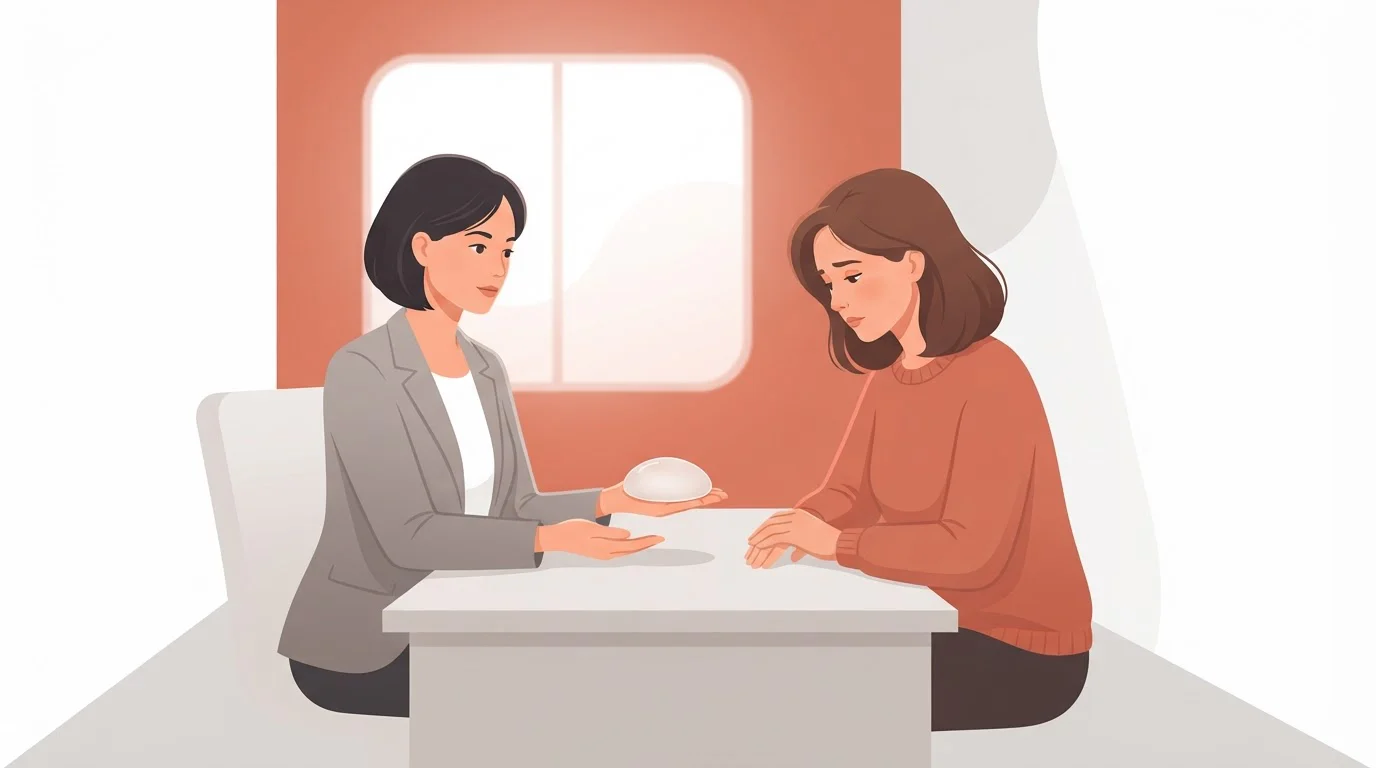
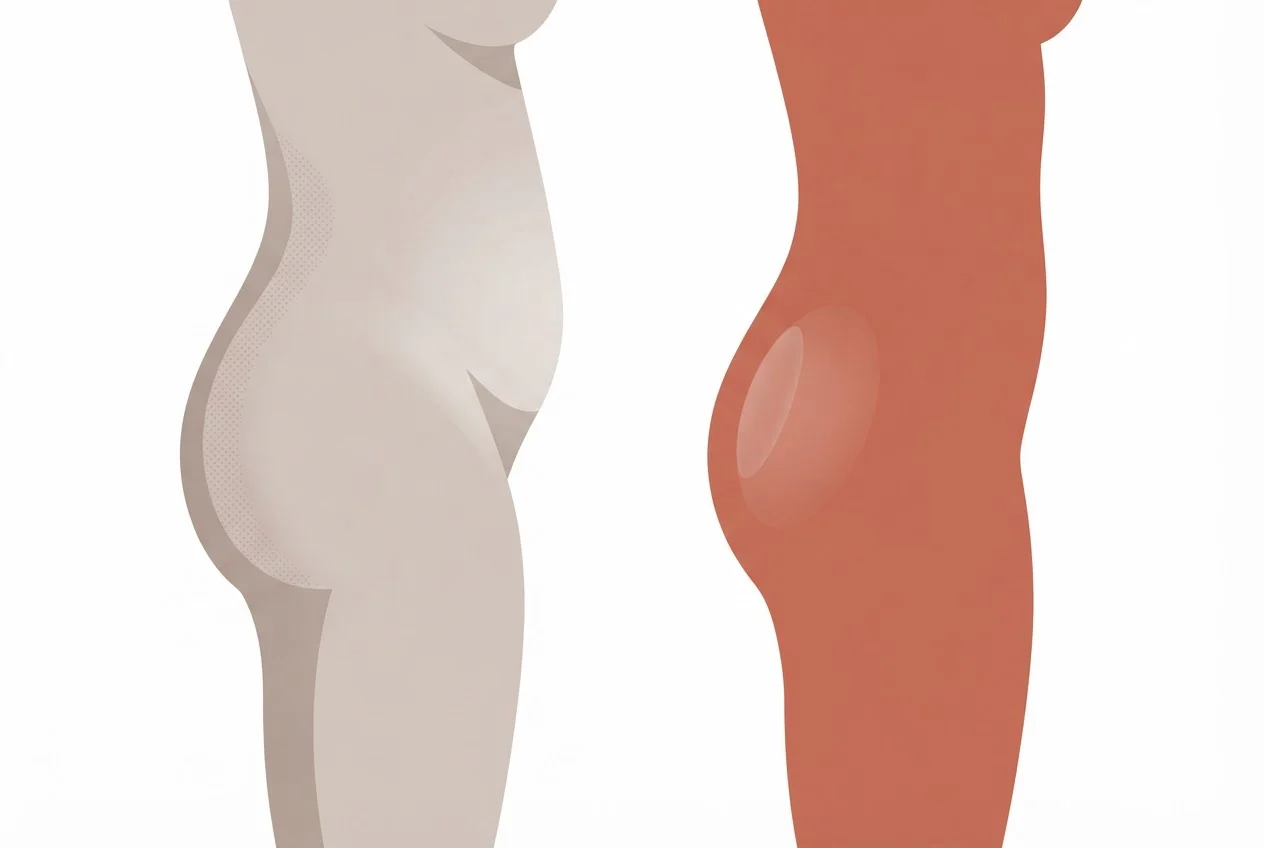
Behind that total sit two very different operations. A Brazilian butt lift, or BBL, is gluteal fat transfer: fat taken from elsewhere on your body by liposuction and placed in the buttocks. A butt implant is a silicone device placed in a pocket your surgeon creates.
Most people searching this want to know which is safer. The plastic-surgery societies have written detailed guidance on how to do fat transfer safely, but none of it tells you which method to choose. This article sets out what that guidance says, what published studies can and cannot tell you, and the questions that decide the choice for you.
BBL vs butt implants: what is actually different?
A Brazilian butt lift (BBL) adds volume from your own fat, taken from another part of your body by liposuction. A butt implant adds volume from a solid silicone device. Each has its own limits and its own list of risks, and the two are chosen for different reasons.
| Comparison | Fat transfer (BBL) | Silicone butt implant |
|---|---|---|
| Where the volume comes from | Your own fat, harvested by liposuction | A solid silicone implant |
| What you need | Enough fat to harvest. ISAPS says very thin patients may not have enough donor fat | ISAPS says implants may suit people who want more volume or projection and have too little donor fat for fat transfer |
| Risks listed by ISAPS | Bleeding, infection, seroma (fluid collection), fat necrosis (fat that dies), oil cysts, contour irregularities, asymmetry, loss of volume, blood clots and fat embolism (fat entering the bloodstream) | Bleeding, infection, seroma, wound separation, implant exposure or extrusion, malposition, displacement or rotation, capsular contracture (firm scar tissue around the implant), nerve injury, and revision, replacement or removal |
| Further procedures | ISAPS says additional fat grafting may occasionally be recommended to reach or keep the contour | ISAPS says implants should not necessarily be considered lifetime devices |
Why "intramuscular" means two different things
The word causes real confusion. For an implant, ISAPS says the device is commonly positioned within the gluteus maximus muscle, although the precise technique depends on your anatomy. That is a planned pocket for a solid device, and surgeons use different planes. For fat, injection into the muscle is the hazard the societies warn about. A surgeon who says your implant will sit "in the muscle" is not describing fat going into the muscle.
What we offer
We offer fat transfer as Safe Subcutaneous Buttock Augmentation (SSBA), silicone buttock implants for patients without sufficient donor fat, and a combined approach, all described on our Buttock Augmentation page.
What do the plastic-surgery societies say about BBL safety?
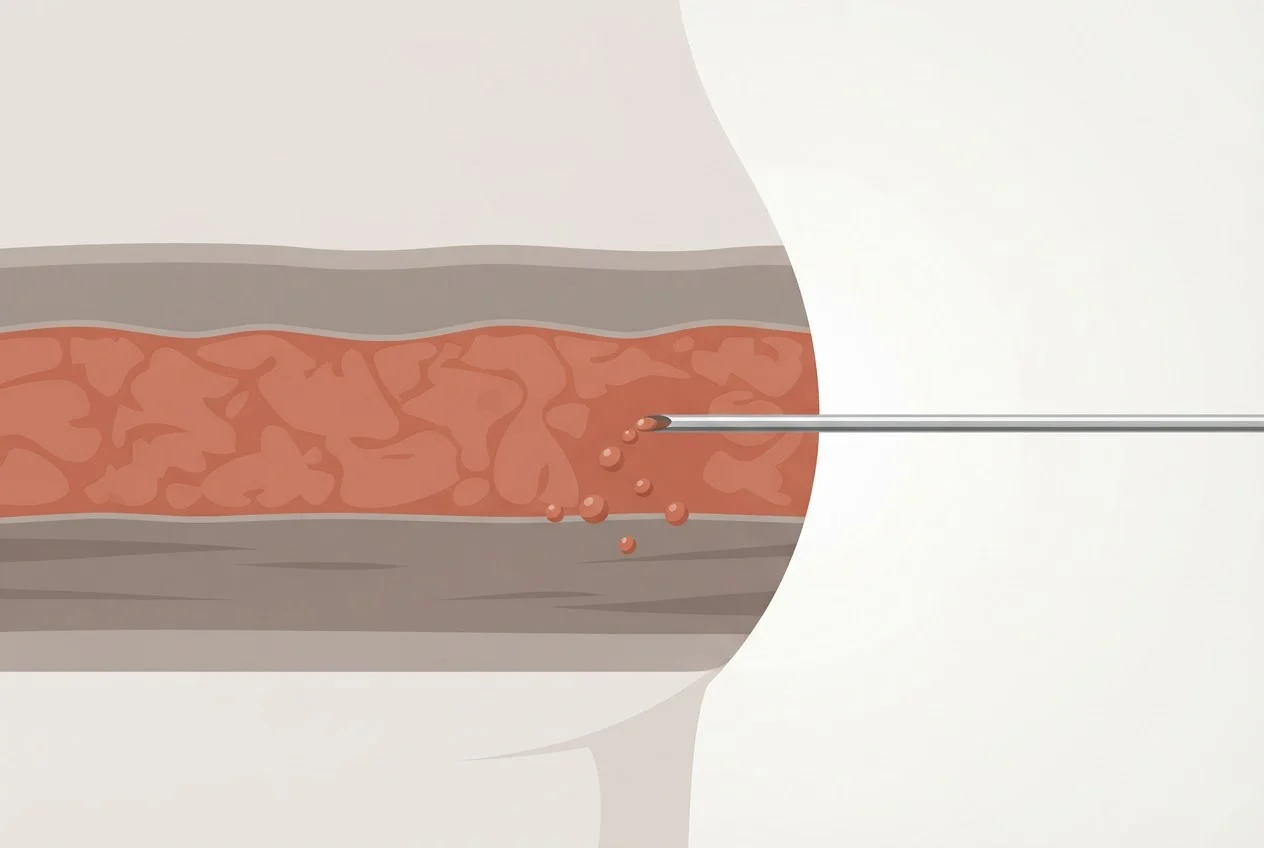
The societies say fat for a BBL goes into the subcutaneous tissue, the layer just under the skin, and never into the muscle. This rule comes from the Multi-Society Task Force for Safety in Gluteal Fat Grafting, and it is guidance for surgeons on how to do fat transfer, not advice on whether to choose it over an implant.
The rule: subcutaneous only
The Task Force brings together the American Society for Aesthetic Plastic Surgery, the American Society of Plastic Surgeons, ISAPS, the International Federation for Adipose Therapeutics and Science and the International Society of Plastic Regenerative Surgeons. Its advisory of July 2018 linked deaths to fat placed in the muscle and concluded that fat should never go there, only into the subcutaneous tissue. It noted that the subcutaneous plane has not been linked to pulmonary fat embolism, where fat reaches the lungs.
In July 2018 the Australasian Society of Aesthetic Plastic Surgeons quoted its vice president as calling the BBL "by far the most dangerous cosmetic procedure a Surgeon can perform" and repeated the same rule. Estimates of the death rate have varied.
When the ASPS president discussed the figures in 2022, he said survey data had once suggested a rate as high as 1 in 3,000 and that more recent survey data suggested roughly 1 in 15,000 after surgeons changed technique. These are survey estimates, mostly from US surgeons, and a 2023 survey study noted that an up-to-date international estimate is still needed.
Why "subcutaneous only" is a standard, not a guarantee
The same advisory warns that it is easy to enter the muscle unintentionally during a subcutaneous injection. A retrospective review of 1,815 patients (Aesthetic Surgery Journal, 2024) reported that touch alone is not enough to confirm the plane and that ultrasound guidance was associated with an improved safety profile.
The joint statement of 18 August 2022 from the American Society of Plastic Surgeons and partner societies calls real-time imaging during injection a "common-sense step" towards staying above the fascia, and supports regulator mandates requiring ultrasound. ISAPS patient guidance likewise describes fat placement only above the gluteal fascia with real-time ultrasound. The evidence is still developing, though: a 2026 scoping review of nine studies found that ultrasound appears to be a useful safety adjunct but that the evidence is limited and mostly non-comparative.
Practice is not uniform. A survey by Finkelstein and colleagues of US plastic surgeons had a 10% response rate. Of the 128 respondents who performed BBL, 80 did not use ultrasound, and about 60% of all respondents disagreed with regulations requiring it. This is US data with a low response rate, so it shows that practice varies, not what happens in India. ISAPS suggests asking your surgeon about technique, facility accreditation, safety protocols and the use of ultrasound.
What the societies do not tell you
None of these documents ranks fat transfer against implants. The 2018 advisory asks surgeons to cover alternatives such as gluteal implants when obtaining consent. The American Society of Plastic Surgeons' buttock enhancement safety page lists risks for buttock surgery in general, including anaesthesia risks, bleeding, infection, fluid collections, fat necrosis, poor wound healing, deep vein thrombosis (a blood clot in a deep vein), cardiac and pulmonary complications, and the possible need for revision.
At our practice we place fat in the subcutaneous plane only and do not perform traditional intramuscular BBL, as our Buttock Augmentation page explains. That follows the societies' rule on placement. It does not make surgery risk-free.
What do studies show about butt implant complications, and what can't they show?
Pooled studies report higher overall complication rates for butt implants than for fat grafting, but they cannot tell you which method is safer for you. They combine different patients, definitions and years, and they predate the 2018 placement rule. The figures below describe what was reported, not a ranking.
| Technique | Sinno 2016 | Oranges 2017 | Asserson 2019 |
|---|---|---|---|
| Fat grafting | 9.9% | 10.5% | 6.8% |
| Silicone implants | 21.6% | 30.5% | 31.4% |
| Local flaps | not in this table | 22% | 23.1% |
- Sinno and colleagues (Plastic and Reconstructive Surgery, 2016): a systematic review comparing silicone implants (2,375 patients) and autologous fat grafting (3,567 patients).
- Oranges and colleagues (Aesthetic Surgery Journal, 2017): a systematic review of 52 papers published from 1969 to 2015, covering 7,834 patients. Patient satisfaction was reported as consistently high across all techniques.
- Asserson and colleagues (Annals of Plastic Surgery, 2019): a systematic review of 46 articles covering 4,362 patients treated between 1992 and 2017.
Local flaps move your own skin and tissue to build the contour; Oranges and colleagues identified them as most suited to people after massive weight loss.
Three limits matter. First, these are pooled, non-comparative studies from 2016 to 2019 that did not compare the methods in the same patients. Second, an overall rate counts everything from minor problems such as fluid collections to serious ones, and it cannot show how a rare event such as fat embolism weighs against them.
Fat grafting includes that rare, serious risk, which a low overall percentage does not capture. Third, the underlying studies ended in 2015 to 2017, before the Task Force's 2018 advisory, so none describes fat transfer done to today's guidance.
Where an implant sits also matters. A meta-analysis of 32 studies and 2,682 patients (Plastic and Reconstructive Surgery, December 2025) found the most seroma and wound separation with subfascial placement (beneath the covering of the muscle but above the muscle) and fewer complications with intramuscular and submuscular placement. These planes describe implant pockets, not where fat is injected. Ask where your implant would sit and why.
ISAPS adds that infection around a gluteal implant can be particularly serious and may require the implant to be removed.
Brazilian butt lift vs butt implants: which suits you?
Which suits you depends on how much donor fat you have, your frame and weight stability, how much volume and projection you want, and which risks you would rather carry. The table lists factors to discuss with your surgeon. It is not a recommendation, and your examination can change any row.
| Factor | Often discussed in favour of fat transfer | Often discussed in favour of an implant |
|---|---|---|
| Donor fat | Enough fat to harvest from areas such as the abdomen, flanks or thighs; our guide to the body areas liposuction can treat lists them | Too little donor fat for meaningful fat-transfer augmentation, per ISAPS |
| Frame and health | Near your ideal weight, healthy and a non-smoker, per the American Society of Plastic Surgeons | A very thin frame with little donor fat; our service page lists implants for patients without sufficient donor fat |
| Volume and projection | Wanting added volume that your available donor fat can provide | Wanting more volume or projection than fat can supply |
| Risks you would rather carry | A rare but serious fat embolism risk if the plane is wrong, plus fat necrosis and loss of volume | Device risks: infection, displacement, wound problems, possible removal or replacement |
| Further surgery | Willing to consider additional fat grafting if recommended | Accepting that future surgery may be needed |
Can you have both?
A combined approach uses an implant for structure and fat for contour, and we offer it. It brings the considerations of both methods, so the risk list in each column applies, and ISAPS says combining procedures must be carefully evaluated for safety, anatomy and the extent of surgery. Whether it suits you is a decision for the consultation, not the internet.
What if you have a thin frame?
A thin frame often points towards an implant, because fat transfer needs fat to harvest and ISAPS says very thin patients may not have enough. We would measure rather than guess. In some people a modest fat transfer is still possible, and in others a combined approach or an implant is worth discussing. Gaining weight to create donor fat is a separate decision with its own consequences.
If the table does not tell you where you sit, a consultation settles it by examination rather than guesswork. You can ask for a consultation: we assess your medical history and candidacy, discuss the options and their risks, and then give you a written plan and quote.
BBL vs butt implants recovery: how do they differ?
Both operations need careful positioning, a compression garment and a gradual return to exercise, but the area you protect differs. The table summarises general society guidance, not a timetable; your surgeon's instructions on sitting, garments and exercise override it.
| Column | Fat transfer (BBL) | Silicone implant |
|---|---|---|
| Early positioning | Pressure on the grafted area may need limiting (ISAPS) | Direct pressure on the buttocks is limited; rest on your abdomen or sides (ISAPS) |
| Sitting | Instructions vary with where the fat was placed | Modified sitting or specialised support; duration varies by technique, implant position and incision healing |
| Compression | Over the liposuction donor areas | May be recommended; direct compression over the implants may be modified |
| Desk-based work | Roughly one to two weeks | About two weeks or longer |
| Exercise | Strenuous exercise and heavy lifting resumed gradually | Squatting, heavy lower-body training and running avoided until cleared |
| Results settle | Swelling eases over weeks; residual changes can last months | The final result becomes clearer over several months |
The Indian Association of Aesthetic Plastic Surgeons describes similar rules after fat transfer: sleeping on your front or sides for about three weeks, avoiding sitting for the first 10 to 14 days except for the toilet, then sitting on a soft pillow or ring cushion under the thighs, and wearing a compression garment for about three to four weeks. Dr Rajat Gupta is the association's National Secretary.
How do BBL and butt implants look, feel and last?
Fat transfer gives a result made of your own tissue, part of which is reabsorbed, while an implant gives a fixed volume that is a device and may need further surgery later. Neither comes with a guarantee, and how natural either looks depends on your anatomy, the volume chosen and the surgeon's technique.
Fat transfer. Part of the transferred fat establishes a blood supply and stays as living tissue, and part is reabsorbed. In an American Society of Plastic Surgeons article from March 2022, Dr J. Peter Rubin estimates that 20 to 40% of injected fat is absorbed during healing, and ISAPS says additional fat grafting may occasionally be recommended to achieve or maintain the contour. Weight changes will also change the result, so it helps to start at a stable weight.
Implants. The volume is set by the device you choose, and how it looks and feels depends on how much of your own tissue covers it. ISAPS describes gluteal implants as designed to give long-lasting augmentation but not necessarily lifetime devices, because future surgery may be required for implant-related complications.
Our view on "natural". Fat blends with your own contours because it is your tissue, and an implant gives a defined, predictable shape. Which you would call natural is personal, so we would rather you saw how each is planned for your body than chose from a word. You can see examples on our fat grafting results page; individual results vary, and photographs are not a promise.
How much do SSBA and butt implants cost?
As of November 2026, our Buttock Augmentation page lists ₹1.2L – ₹2.75L for SSBA and ₹3.5L – ₹5L for silicone implants. L stands for lakh, 1,00,000 rupees. We do not publish a price for the combined approach. Pricing is per case, with a written estimate after consultation.
Because each plan is individual, a headline number tells you little until your surgeon has examined you. Compare quotes by what they include rather than by the total. Ask whether the written estimate covers:
- pre-anaesthetic assessment
- theatre care
- a hospital or day-care stay
- garments
- follow-up visits
- what happens, and at whose cost, if you need a further procedure
Pass: each item is listed, in writing, with a rupee amount or a clear "included". Fail: a single figure with no breakdown, or a verbal number.
What should you ask any surgeon before choosing?
Ask seven questions, and treat a vague answer to any of them as a fail. The questions apply to us too, and we expect you to ask them.
- Are they registered, and is the qualification real?
Search the name on the National Medical Commission's Indian Medical Register. Pass: name, registration number and qualification match what you were told. Fail: no registration number, or no match. Check any society membership with the member search of the Association of Plastic Surgeons of India or the Indian Association of Aesthetic Plastic Surgeons. For reference, our lead surgeon, Dr Rajat Gupta, holds MBBS, MS and DNB (Plastic Surgery) qualifications and is the National Secretary of the Indian Association of Aesthetic Plastic Surgeons, so please do not take our word for it: ask for his registration number and check it on the register.
- Which plane will the fat go into, and how do you confirm it during the operation?Pass: subcutaneous only, never the muscle, with a clear explanation of how the plane is confirmed. Fail: "I'm experienced", or any plan that includes the muscle.
- For an implant: which plane, and what happens if there is an infection or exposure?Pass: reasons given for the plane and a plan for problems, including removal if needed. Fail: "there is no risk".
- How much donor fat do I have, and what is realistic from it?Pass: assessed on examination. Fail: a promise before they have examined you.
- Where will it be done, and what emergency cover is there?
The US societies' 2022 statement says office-based gluteal fat grafting should be done only by surgeons with privileges at a licensed ambulatory surgery centre or hospital. In India, ask which hospital or theatre, and who responds to an emergency. Our facilities page describes our clinic and where we work. Pass: named facility and emergency arrangements. Fail: no answer.
- If something goes wrong, who treats me, where, and who pays?Pass: a written answer. Fail: "it depends".
- Is the quote itemised and in writing, and can I think about it?Pass: an itemised estimate and no pressure to commit on the day. Fail: a verbal number or a deadline.
What should you know before travelling for buttock surgery?
Official health bodies warn that surgery abroad carries extra risks, mainly around follow-up, infection and travel. Agree the aftercare plan before you travel, and keep your records.
The NHS guidance on cosmetic surgery abroad warns that safety standards may differ, that overseas clinics may not provide follow-up treatment, and advises you to ask what happens if complications arise, where follow-up takes place and what it costs, and to check the surgeon's qualifications and training.
The US Centers for Disease Control and Prevention (CDC) lists infection as the most common complication of medical tourism, notes that surgery and air travel each raise clot risk, advises you to request your overseas records in English, and warns that follow-up care can carry substantial fees.
Ask for the follow-up plan in writing before you book, wherever you choose to have surgery.
Choosing between a BBL and butt implants: where to start
Start with three facts about your own body: how much donor fat you have, how stable your weight is, and the kind of volume you want. Everything else, including the technique, the plane and the surgeon, should follow from those and be explained to you in writing.
The societies' guidance tells surgeons how to do fat transfer more safely: subcutaneous placement only, never the muscle. Implants carry their own risks, and no study can say which is safer for you. No procedure is risk-free, and a surgeon who says otherwise is a reason to look elsewhere.
If you would like an assessment of your donor fat, your options and the risks of each, we see patients at several Delhi locations, including Excel Hospital in Shalimar Bagh, and by video for those outside Delhi. Timings differ by location, so we confirm yours when you book a consultation. We will explain both routes before you decide.
Book a consultation on BBL or butt implants
Frequently asked questions
Sources
- 1.ISAPS, International Survey on Aesthetic/Cosmetic Procedures Performed in 2024, full report (released 19 June 2025)
- 2.Multi-Society Task Force for Safety in Gluteal Fat Grafting, Safety advisory, July 2018
- 3.American Society of Plastic Surgeons and partner societies, Gluteal fat grafting: a joint safety statement, 18 August 2022
- 4.Australasian Society of Aesthetic Plastic Surgeons, Brazilian butt lift warning, 12 July 2018
- 5.ISAPS, Fat transfer / body fat grafting
- 6.ISAPS, Buttock augmentation with gluteal implants
- 7.American Society of Plastic Surgeons, Seven things you need to know about a Brazilian butt lift, 28 March 2022
- 8.American Society of Plastic Surgeons, Buttock enhancement safety
- 9.Finkelstein et al., Aesthetic Surgery Journal 44(1), 2024
- 10.Ultrasound in gluteal fat grafting: safety tool, standard of care, or emerging evidence? A scoping review, Aesthetic Surgery Journal, 2026
- 11.Augmented safety profile of ultrasound-guided gluteal fat transfer: retrospective study with 1,815 patients, Aesthetic Surgery Journal 44(4), 2024
- 12.Sinno et al., Plastic and Reconstructive Surgery 137(4), 2016
- 13.Oranges et al., Aesthetic Surgery Journal, 2017
- 14.Asserson et al., Annals of Plastic Surgery, 2019
- 15.Elsaftawy et al., implant-based gluteal augmentation meta-analysis, Plastic and Reconstructive Surgery, December 2025
- 16.NHS, Cosmetic surgery abroad
- 17.US Centers for Disease Control and Prevention, CDC Yellow Book: Medical tourism (last reviewed 23 April 2025)
- 18.National Medical Commission, Indian Medical Register
- 19.Association of Plastic Surgeons of India
- 20.Indian Association of Aesthetic Plastic Surgeons, Find a surgeon
- 21.Indian Association of Aesthetic Plastic Surgeons, Buttock augmentation
- 22.Dr Rajat Gupta, Buttock Augmentation
- 23.Dr Rajat Gupta, Body areas liposuction can treat
- 24.Dr Rajat Gupta, Fat grafting results
- 25.Dr Rajat Gupta, Facilities