Breast Lift After Pregnancy and Breastfeeding: When to Wait
A breast lift after pregnancy and breastfeeding is usually advised from about six months after your last feed, later if weight or breast size has not settled. Published advice runs from roughly three to twelve months.
Updated 30 Oct 2026

Key takeaways
- Plan a breast lift from about six months after your last feed, later if weight or breast size is still changing. Published advice ranges from roughly three to twelve months.
- Readiness is a set of signs, not a date: no milk, steady bra fit, steady weight and a settled decision about family size. Surgeons generally advise against a lift while breastfeeding.
- Breastfeeding is often possible after a lift but cannot be guaranteed, because some women make too little milk. Tell your surgeon before surgery if you hope to feed another baby.
- A lift changes the position of the breast, not its volume. Every effective lift leaves scars, and another pregnancy may stretch the result.
In this article
- 1What does a breast lift after pregnancy and breastfeeding change?
- 2How long after breastfeeding can you get a breast lift?
- 3Can you have a breast lift while you are still breastfeeding?
- 4What if you did not breastfeed?
- 5A worked example of the arithmetic (illustrative)
- 6How do you know your breasts have settled?
- 7Can you breastfeed after a breast lift?
- 8Should you finish having children before a breast lift?
- 9How long after a lift can you get pregnant?
- 10Lift alone, lift with an implant, or breast reduction?
- 11What happens at a breast lift consultation?
- 12What scars and risks should you expect?
- 13Can you plan a breast lift from outside Delhi or from abroad?
- 14When is the right time for your breast lift?
- 15Frequently asked questions
Reviewed by Dr Rajat Gupta, plastic surgeon, RG Aesthetics, Delhi. Review date: 29 October 2026.
Two questions come up most often about a lift after a baby. How long do I wait? And will it cost me my milk if I have another child? The first has a range of answers. The second has a less tidy one.
Your breasts keep changing for months after the last feed. A lift planned on a breast that has not settled may not hold its intended position, and a revision (a further operation to adjust the result) may need to be discussed later.
The evidence on feeding is limited. In Faure et al., 2024, breastfeeding success was 82% for women who had a pregnancy before breast reduction or lift surgery, and 41% for those whose pregnancy came after.
This page gives you a timing table, a home checklist and questions for your surgeon. It then covers feeding after a lift, another pregnancy, and the choice between a lift, a lift with an implant and a reduction.
What does a breast lift after pregnancy and breastfeeding change?
A breast lift (mastopexy) raises the breast and nipple by removing loose skin and reshaping the tissue underneath. It changes position, not volume. Mayo Clinic says a lift alone does not change breast size.
Pregnancy, rather than nursing itself, is generally considered the main driver of these changes. In pregnancy the breast grows and the skin and its supporting tissue stretch. Afterwards the glandular tissue shrinks and the skin does not always tighten again. Weight change, age, genetics and the number of pregnancies add to this. Feeding your baby did not cause it, and you did nothing wrong.
Our guide to sagging breasts after breastfeeding covers the causes in detail, and our page on whether saggy breasts can be lifted explains the options.
A lift can move the nipple back to a higher position, remove excess skin and tighten the shape. It cannot refill an emptied upper breast, stop future stretching or promise a result that never changes. At our breast lift service we use crescent, periareolar (around the areola), vertical and inverted-T (anchor) lifts. We choose between them by examining how much skin and drop you have.
How long after breastfeeding can you get a breast lift?
Plan for about six months after your last feed, and longer if your weight or breast size is still changing. The sources differ. The American Society of Plastic Surgeons (ASPS) says breasts can take four to six months to contract after feeding stops. A surgeon quoted on that page waits at least three months after weaning. Mayo Clinic advises six months to a year. There is no single consensus. In our judgement the date matters less than whether the breast has stopped changing.
| Factor | Why it matters | How you will know |
|---|---|---|
| Milk production and hormones | A breast still making milk changes size, which makes a lift hard to plan. | No milk leaks or can be pressed out. Your surgeon confirms on examination. |
| Weaning | The breast takes months to contract to its post-pregnancy size, and may not return to its earlier size. | Your bra size and fit stay the same across several weeks. |
| Weight stability | Weight change alters breast volume and skin. | Your weight stays about the same over several weeks without dieting or deliberate gain. |
| Finishing your family | Another pregnancy can stretch the breast again and offset the lift. | You have made the family-size decision, or know when you plan another pregnancy. |
Can you have a breast lift while you are still breastfeeding?
Surgeons generally advise against it. The breast is still changing in size and shape, so the result is hard to plan. You do not need to stop feeding earlier than you wish for the sake of a lift. It can wait until you have finished in your own time.
What if you did not breastfeed?
The settling checks still apply. After a birth the breasts go through hormonal changes whether or not you feed, so they also need time to settle. Published guidance for mothers who did not breastfeed is thin. In our judgement, about six months after the birth is a reasonable earliest point, provided your weight is steady, you have recovered from the delivery and you know whether you plan another pregnancy. Count from the date of the birth, or from the day any milk supply fully stopped if you fed briefly, and then run the checklist below.
A worked example of the arithmetic (illustrative)
The dates below are invented to show the counting. They are not a patient's case and not advice. Suppose the last feed of any kind was on 1 March.
| Marker | Date | What it means |
|---|---|---|
| Three months | 1 June | The shortest minimum quoted by surgeons. The checks below must still pass. |
| Six months | 1 September | A common planning point. |
| Twelve months | 1 March, the following year | The upper end of the range for a breast that is slow to settle. |
Two mistakes are common. People count from when they began cutting down feeds rather than from the last feed of any kind. And they book by date while their weight is still falling. Count from the last feed, then book once the checklist passes.
How do you know your breasts have settled?
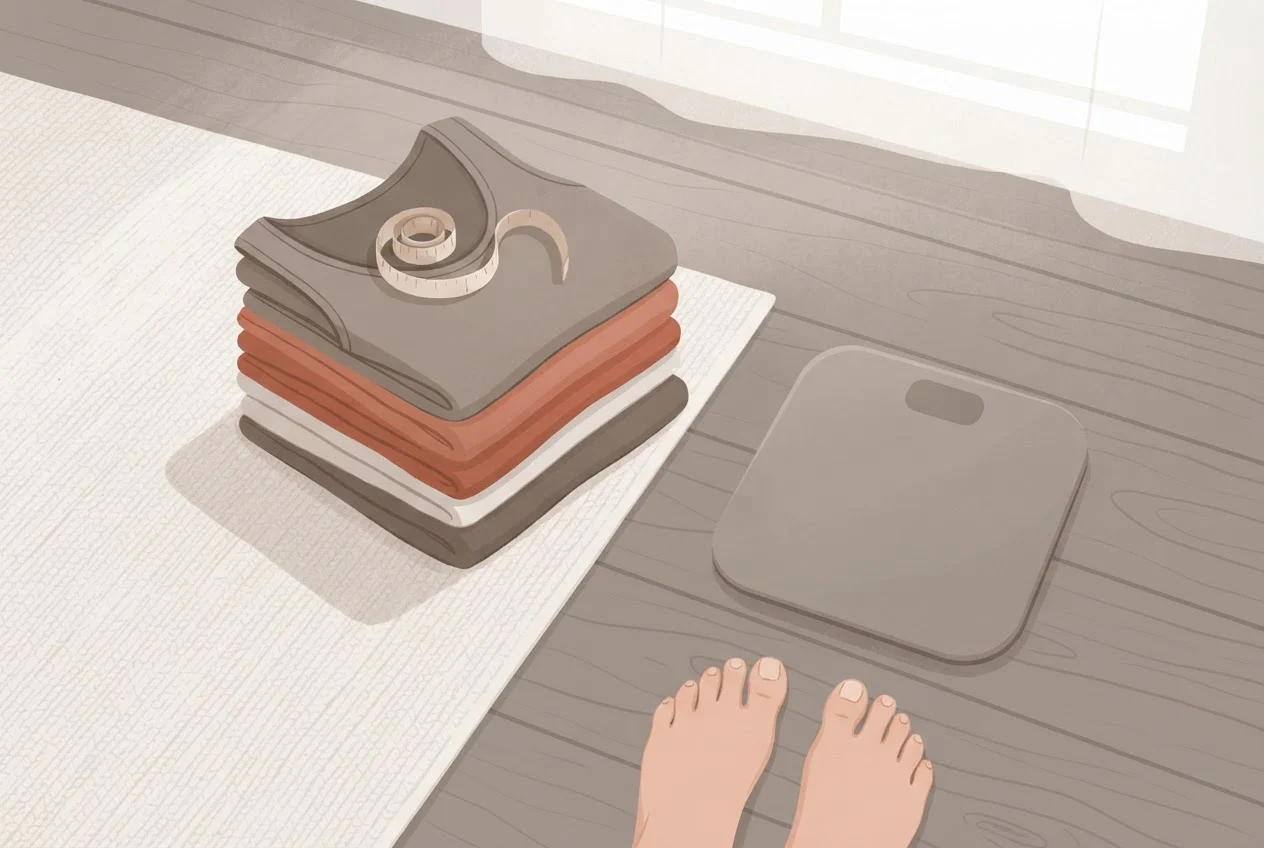
You are ready when every test below passes and your surgeon confirms it on examination. Any fail means wait longer.
- No milk.Pass: no leaking and no milk when you press gently once. Fail: any milk. Do not repeat the test.
- Steady fit.Pass: the same bra size and cup fit across several weeks. Fail: a fit that is still loosening or changing.
- Steady weight.Pass: weight holds about the same over several weeks without active dieting. Fail: you are still losing or gaining.
- Family decision made.Pass: you can say whether you plan another pregnancy, and when. Fail: you are undecided and may conceive soon.
- Time since your last feed.Pass: about six months or more since the last feed of any kind, or an earlier date that your surgeon has confirmed on examination. Fail: under about six months without your surgeon's agreement, or your surgeon has advised waiting longer.
Wait longer if the breast is still softening or shrinking, or if anything in the list is a fail. If you are unsure, bring your last-feed date and your weight over the past few months to a consultation. Our recommendation is to let the checks decide the date, not the other way round.
Who is a good candidate for a breast lift after pregnancy?
A lift tends to suit mothers whose breasts sit lower than they would like, whose nipples point downwards or sit below the fold under the breast, and who are otherwise in good health. In our judgement, the points that matter most are these:
- Your weight is steady, as covered above.
- You have finished breastfeeding and the settling checks have passed.
- You understand that a lift repositions the breast and does not add volume.
- You have thought about further pregnancies.
- You do not smoke, or you are prepared to stop before surgery, because smoking affects healing.
Your surgeon decides this on examination, including how much skin and drop you have. If you mainly want more fullness or a smaller breast, a lift alone is not the right operation. The options table below shows the alternatives.
Can you breastfeed after a breast lift?
Often yes, but it cannot be guaranteed. Most women are still able to breastfeed after a lift (ASPS), and feeding is usually possible, though some women make too little milk (Mayo Clinic). Breastfeeding may still be possible after a lift, but we cannot promise it.
The best recent evidence is a Henri-Mondor hospital study (Faure et al., 2024), published in Annales de Chirurgie Plastique Esthétique. Using a questionnaire, it compared 104 women who had a pregnancy before breast reduction or lift with 61 who had a pregnancy after. Breastfeeding success was 82% before surgery and 41% after. Too little milk was the most common reason for failure after surgery.
Its limits matter. It is small, retrospective (looking back at past cases) and single-centre. The two groups are different women, not the same women measured twice. Reduction and lift were combined, so 41% is not a rate for lifts alone. Reduction removes gland tissue and a lift mainly moves it, so a lift may affect supply less. That is our inference. The study cannot show it.
If you hope to feed another baby, tell your surgeon at the start and ask:
- Which lift technique suits my shape, and where will the scars sit?
- Will my nipple stay attached to its blood and nerve supply? (The strip of tissue that keeps the nipple connected is called a pedicle.)
- Will tissue be moved or removed?
- Does my own feeding history, such as low supply before, change the risk?
- What do you advise if I conceive again after the lift?
Should you finish having children before a breast lift?
If you can, yes. Another pregnancy can stretch the breast again and offset part of a lift, which is why Mayo Clinic notes that you might wait to have a lift if you plan to become pregnant. A lift does not stop you becoming pregnant. It is very safe to get pregnant after a lift, but results are not guaranteed, and a lift can be revised if sagging returns (ASPS).
So a lift before or after having children is a question of what you are prepared to repeat. In our judgement, if you may have another child within the next couple of years, waiting is usually the more sensible course. If your family is complete, nothing beyond the settling checks needs to delay you. If you are undecided, settle that first, because it affects the timing more than anything else.
How long after a lift can you get pregnant?
Neither Mayo Clinic nor the ASPS gives a fixed waiting period between a lift and a pregnancy. The ASPS describes pregnancy after a lift as very safe. In our judgement, most surgeons prefer your wounds to be healed and the breast shape to be settled first, and a pregnancy soon after a lift is more likely to change the result. Ask your surgeon for a date based on your own healing, and tell them before surgery if another pregnancy may come within a year or two.
Lift alone, lift with an implant, or breast reduction?
Choose by volume. A lift alone suits breasts you are happy with in size but that sit low. A lift with an implant suits breasts that have also lost fullness. A reduction suits breasts you want smaller or lighter.
| Option | What it changes | May suit | Trade-offs |
|---|---|---|---|
| Lift alone | Position, skin and shape. Volume stays as it is. | Good volume but low position | Scars. The result can loosen with pregnancy, weight change and time. |
| Lift with an implant | Position plus added volume | Lower and emptier upper breast | Adds implant-related issues and possible future replacement. See capsular contracture and what happens to implants over time. |
| Breast reduction | Smaller, lighter breast, with lifting as part of the operation | Breasts that are heavy or too large | Tissue is removed, so feeding may be affected. Our complete guide to breast reduction explains how it differs from a lift. |
Our guide to combining augmentation and a lift covers the middle option. If you are also thinking about your abdomen, our page on a tummy tuck after a Caesarean section deals with that timing separately.
What happens at a breast lift consultation?
At a consultation we take your history, examine you, discuss options and risks, and then give you a written surgical plan and estimate. Bring the date of your last feed, your weight over the past few months, any photographs from before pregnancy, and your plans for more children.
You will meet Dr Rajat Gupta, who holds a DNB in Plastic Surgery and completed breast-surgery fellowship training at Hospital Sant Pau, Spain. You receive a written plan and estimate only after examination. We will tell you if we think you should wait, and we do not push surgery.
If you would like to talk it through, you can Book a Consultation.

What scars and risks should you expect?
Every effective lift leaves scars, and no lift is guaranteed to last. Scars do not go away, but they tend to soften and fade within one to two years, and can mostly be covered by a bra or swimsuit (Mayo Clinic).
The risks include difficulty making enough milk afterwards (Mayo Clinic) and a result that may not hold through a later pregnancy and could need revision (ASPS). We go through the full list of surgical risks with you at consultation. Natural breasts are never perfectly matched, so we do not promise perfect symmetry. Pregnancy, weight change and ageing continue after surgery, which is why we avoid describing any lift as permanent.
Can you plan a breast lift from outside Delhi or from abroad?
Yes. We begin with a free video consultation, so you arrive in Delhi with a plan already in place. For international patients we provide an invitation letter and medical records for the medical visa application, and we can also help with travel coordination, accommodation near our Shalimar Bagh practice, and video follow-up after you return home. Our page for international patients explains the process.
We plan your arrival around your surgery date and your return travel. We recommend choosing your date only after the settling checks above have passed, so you do not travel too early. You receive a written quote within 24 hours, and consultations are held in English, with a translator arranged if you need one.
When is the right time for your breast lift?
The right time is when your breasts have stopped changing, your weight is steady and you know whether you plan more children. For most mothers that is around six months after the last feed or later, and sometimes sooner on a surgeon's advice. Feeding afterwards may still be possible, but it cannot be promised.
If you would like to check your own timing, or you live outside Delhi and want to start by video, you can Book a Consultation. We will go through your history and examine you before advising any date.
Check your breast lift timing with Dr Rajat Gupta
Frequently asked questions
Sources
- 1.Mayo Clinic: Breast lift, Mayo Clinic
- 2.ASPS: Post-pregnancy plastic surgery: what can you do now, and what needs to wait, ASPS, 18 June 2026
- 3.ASPS: Breast lifts and pregnancy (video), ASPS
- 4.Faure et al., 2024: Successful breastfeeding after breast reduction surgery or mastopexy, Annales de Chirurgie Plastique Esthétique